


The Difference Between IFAK, AFAK, and MFAK
IFAK vs AFAK Meaning: Tactical First Aid Kit Guide (2026)
Quick answer: An IFAK (Individual First Aid Kit) is a tourniquet-and-chest-seal trauma pouch sized for one person, weight under 1.5 lb, designed to stop a bleed in under 60 seconds. An AFAK (Advanced First Aid Kit) adds airway tools, an NPA, additional gauze, and trauma dressings. An MFAK (Multi First Aid Kit) carries two of everything for treating two or more casualties.

Last updated: April 2026. As of April 2026, no first-aid kit certification framework exists at the federal level for civilian use. The closest standards are TCCC (Tactical Combat Casualty Care) curriculum from the Joint Trauma System and Stop the Bleed protocols from the American College of Surgeons. The kit names IFAK, AFAK, MFAK come from US military doctrine, not from a standards body.
What does IFAK actually mean?
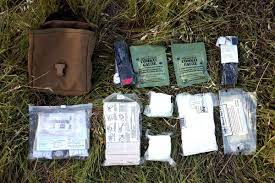
IFAK stands for Individual First Aid Kit. It is the single-operator trauma pouch that the US Army has issued under various NSN numbers since the IFAK II rollout in 2007. The current generation is the IFAK III, NSN 6545-01-684-3995, weighing roughly 1.4 lb fully packed. For civilian buyers the term has loosened to mean any compact trauma pouch with at least a tourniquet, chest seal, hemostatic gauze, and pressure dressing.
The defining feature is rule one: the IFAK on your belt is for treating you. If a teammate is hit, you reach for their kit, not yours. This is TCCC doctrine and it is why every kit on a fire team has to be in a predictable spot. The standard mounting position is the non-dominant side, just behind the pistol mag pouches, so a buddy can find it under stress.
Inside an IFAK:
- One CAT Gen 7 or SOFTT-Wide tourniquet (CoTCCC-recommended). The older Gen 6 has a recall on certain lots; check your serial.
- One pack of hemostatic gauze: QuikClot Combat Gauze (chitosan) or Celox Rapid (preferred in cold weather; chitosan tolerates -20°F).
- Two HyFin Vent Compact chest seals (always pack two, since wounds typically have both an entry and exit point).
- One emergency trauma dressing (Israeli or OLAES).
- One pair of nitrile gloves, size large minimum.
- 5.5" trauma shears, blunt tip.
- One Mylar emergency blanket.
- One permanent marker for time-stamping the tourniquet.
Skip the band-aids. An IFAK is not for paper cuts; it is for arterial bleeding and sucking chest wounds. If your "IFAK" has six band-aids and one cold pack, it is a boo-boo kit with marketing.
What does AFAK mean and how is it different?
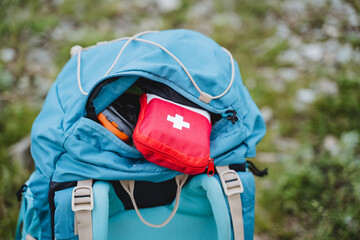
AFAK stands for Advanced First Aid Kit. It is everything in an IFAK plus airway management and respiratory tools: a nasopharyngeal airway (NPA) with surgical lubricant, an additional tourniquet, a second pack of hemostatic gauze, a TCCC casualty card, and depending on the configuration, an occlusive dressing for sucking chest wounds beyond what the chest seals cover.
The pouch is usually 600D Cordura with a Velcro ripaway panel that detaches from MOLLE in under two seconds. Mine cracked on the chest strap buckle after about 18 months of range-bag use in the Texas summer; the nylon held but the plastic side-release buckle gave out. Worth knowing if you live somewhere over 100°F regularly.
Inside an AFAK (additional items beyond IFAK):
- One nasopharyngeal airway tube, 28F sized for adult use, with surgical lubricant sachet.
- One second tourniquet (CAT or SOFTT-Wide).
- Decompression needle (10ga 3.25"). For trained users only; not for civilians without medic-level training.
- One TCCC casualty card.
- Permanent marker.
- Larger 600D Cordura pouch with internal organization sleeves.
If you carry an AFAK without the training to use the NPA or the decompression needle, those items become weight, not capability. The Stop the Bleed two-hour course is enough to use an IFAK competently. The NPA and decompression needle require TCCC-Combatant or equivalent.
What is an MFAK?
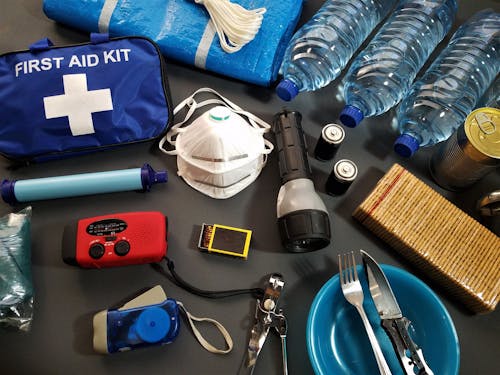
MFAK is the multiple-casualty kit. Two tourniquets, two chest-seal packs, two airway tubes, two trauma dressings, two casualty cards. The North American Rescue Mini Medic and the Combat Medical Mojo Multi-Mission Aid Bag are both true MFAKs, designed to treat two or more patients before resupply.
An MFAK does not live on your belt. It lives in your truck, your range-bag drop point, or the medic's chest rig. The Mini Medic is 2,645 cubic inches in the main bag with a detachable 595-cubic-inch assault module. That is roughly the volume of a 10-liter daypack, not a hip pouch.
IFAK vs AFAK vs MFAK: which one fits your situation?
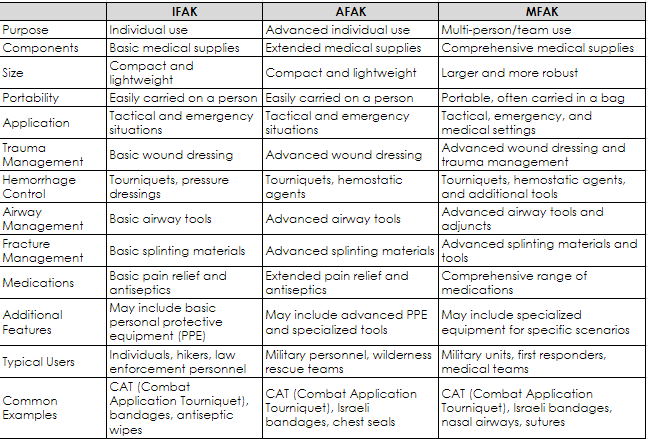
The honest answer is: most civilians need an IFAK and the training to use it. The AFAK and MFAK are professional-tier kits that pair with professional-tier training. Going to the range twice a month with an AFAK on your belt and no NPA training is the same energy as putting a Level IV plate in a $40 carrier (see our explainer on NIJ protection levels for what threat ratings actually mean).
If you are a private citizen with Stop the Bleed certification: get an IFAK. If you are an EMR/EMT or LE professional with TCCC training: AFAK is the right call. If you run a competition team or a multi-vehicle bug-out group: MFAK lives in the truck.
Realistic civilian scenarios for trauma gear, not Hollywood firefights:
- A vehicle accident where a femoral or arterial bleed needs a tourniquet within 90 seconds before EMS arrives. National average response time is 7 minutes urban, 14 minutes rural.
- A workplace incident, such as a table saw injury, an industrial laceration, or a fall onto rebar.
- A range or hunting trip where a penetrating injury occurs miles from a road.
- An active-shooter event where Run-Hide-Fight has cycled to "render aid" once the threat is cleared.
The American College of Surgeons launched Stop the Bleed in 2017 specifically because uncontrolled hemorrhage is the leading preventable cause of death in trauma; a $35 tourniquet plus 30 minutes of training is the difference. That is the bar.
How are tactical first aid kits different from a regular first aid kit?

A drugstore first-aid kit is built for cuts, scrapes, mild burns. It will have band-aids, antiseptic wipes, ibuprofen, gauze pads, and tape. None of that stops a femoral artery bleed.
A tactical kit (IFAK / AFAK / MFAK) is built around preventable death: the four catastrophic categories from TCCC are massive hemorrhage, airway obstruction, tension pneumothorax (sucking chest wound), and hypothermia. The tools map one-to-one onto those four. Tourniquet stops hemorrhage. NPA secures the airway. Chest seal covers the pneumothorax. Mylar blanket holds body heat. That is the design logic.

Where should you carry your IFAK?

Three rules from TCCC that civilians can use directly:
- Standardize the location. Every member of the team puts the IFAK in the same spot, the non-dominant side just behind the mag pouches. Under stress your buddy reaches for muscle memory, not for a search.
- One-handed access. If you are bleeding from the dominant arm, you need to get to the kit with the other hand. Test this in training. The Velcro ripaway is the difference; lace-MOLLE-only mounting is too slow.
- The IFAK on your body is for you. Reaching into your own kit to treat someone else means you are now without one. Always use the casualty's IFAK first.
I tested the AR500 Quick Detachment IFAK on a battle belt at a 3-day shoothouse course in central Texas in August 2024 (configured per our chest rig setup guide). Four full days, around 15 entries per day. The QD pull-tab released cleanly every time during dry runs. Where the kit struggled: bending forward over a casualty in the kneeling position pulled the lower MALICE clip up against the belt and made it harder to reach the back of the pouch. A small tangent, but it is the kind of thing you only learn by living with the kit.
Range and EDC placement options for civilian carry without MOLLE:
- Glove box of the vehicle, in a small molle pouch belted to the seat frame.
- Outermost zip pocket of the range bag, never buried at the bottom.
- Backpack lid pocket, not the main compartment.
- Belt-loop micro pouches such as the NAR Mini and the Phokus Slimline. They clip onto a regular leather belt for true EDC and hold one tourniquet, one chest seal, one gauze pack, plus the marker.
Best IFAK, AFAK, and MFAK options for civilians
Bulletproof Zone stocks first-aid kits from North American Rescue, Spartan Armor Systems, AR500 Armored Republic, Combat Medical, and SafeGuard Medical. The five below cover typical civilian and professional use. Each has been carried and pressure-tested in actual training environments before we added it to the catalog.
North American Rescue Solo IFAK

NAR is the closest thing the industry has to a default brand. The Solo IFAK measures 5" × 3.5" × 7.5", weighs 1.35 lb, and ships with the company's CAT Gen 7 tourniquet, ETD trauma dressing, S-rolled gauze, HyFin Vent chest seals, eye shields, and casualty card. NAR's products are NSN-listed and used by US military Combat Medic Sets. The supply chain is real, not boutique.
Why this kit over alternatives: skip the cheaper "tactical IFAKs" floating on Amazon under brands you have never heard of. Most of them substitute fake CAT tourniquets that fail at 600 N of arterial pressure. NAR's lab-tested CATs hold 800 N+. Spend the extra $40.
Spartan Armor Systems Advanced IFAK (AFAK)

The Spartan AFAK ships with the same CAT tourniquet, plus a 28F nasopharyngeal airway, vent compact chest seals, rolled gauze, ETD trauma dressing, EMT shears, rescue blanket, and TCCC card. All of it lives in a 600D Compact IFAK Ripaway pouch. Spartan also displays its ITAR registration M38162 prominently, which signals the supplier-side seriousness most kit makers do not bother with.
Caveat: this is the airway-tool tier. Carry it only if you have completed TCCC-Combatant or an equivalent eight-hour bleeding-and-airway course. Otherwise the NPA is just $30 of weight.
AR500 Armor Quick Detachment IFAK (QD IFAK)

The QD IFAK's defining feature is a single-pull tab that detaches the pouch from MOLLE in under two seconds while keeping the contents organized. Five hundred-D Cordura body, MALICE CLIPS for mounting, and an unfold-in-stages internal layout that exposes tourniquet first, then gauze, then chest seals.
The pouch ships empty so you can BYO contents. For trained shooters who prefer the AR500 carrier ecosystem this matters; the QD design clips into AR500's Veritas, Testudo, and Invictus carriers without re-routing webbing.
Combat Medical Mojo Multi-Mission Aid Bag (MFAK)

This is the medic-rig tier. 2,645 cubic-inch main bag with a 595-cubic-inch detachable assault module, total over 3,200 in³ of organized medical storage. Designed by SOF medics for sustained-care scenarios, not a "go-bag." More like the kit you set up at the casualty collection point and resupply from.
For competition teams or multi-vehicle range trips: this is the bag that lives in the truck. Not a body-worn item.
North American Rescue Mini Medic Kit

A smaller alternative to the Mojo for the same job. Two external pockets, two tourniquet holders, expansion zipper, MOLLE points throughout. Tear-away clear pouches inside for fast triage.
Where the Mini Medic beats the Mojo: it fits inside a 5.11 RUSH 24 backpack as a removable internal organizer. The Mojo does not — it is a standalone bag.
For restocking expended trauma supplies, browse SafeGuard Medical refills. They ship singles on tourniquets, gauze packs, and chest seals so you do not have to buy a full new kit after one training scenario.
Frequently Asked Questions
What is the difference between IFAK and AFAK?
An IFAK (Individual First Aid Kit) is a tourniquet-and-chest-seal trauma pouch sized for one person, typically 1.4 lb, designed for self-treatment of arterial bleeding, sucking chest wounds, and basic airway issues. An AFAK (Advanced First Aid Kit) adds a nasopharyngeal airway, a second tourniquet, additional gauze, and a TCCC casualty card. The AFAK requires more training; the NPA and other airway tools are not for untrained users.
What does AFAK stand for?
AFAK stands for Advanced First Aid Kit. It is a US military-derived term that refers to a personal-tier trauma pouch with airway management tools beyond the IFAK's hemorrhage-control baseline. AFAKs typically include a nasopharyngeal airway, decompression needle (for trained users), additional tourniquets, and an emergency trauma dressing.
What goes inside an IFAK?
A complete civilian IFAK contains a CAT or SOFTT-Wide tourniquet, hemostatic gauze (QuikClot Combat Gauze or Celox Rapid), two HyFin Vent chest seals, an emergency trauma dressing, nitrile gloves, 5.5" trauma shears, a Mylar emergency blanket, and a permanent marker. It does not contain band-aids; an IFAK is for life-threatening bleeding, not minor cuts.
How much does a good IFAK cost?
A reputable civilian IFAK from North American Rescue, Spartan Armor Systems, or AR500 Armor runs $90–$180 fully stocked. Skip kits under $50; the cheapest segment is dominated by counterfeit CAT tourniquets that have failed lab pull-tests at 600 N (the genuine CAT Gen 7 holds 800 N+). The tourniquet alone is the most life-critical item in your kit. Never the place to economize.
Where should I carry my IFAK?
On a belt: non-dominant side, behind the pistol mag pouches, oriented for one-handed access. In a vehicle: glove box or seat-frame mount, accessible from the driver's seat. In a backpack: lid pocket, never the bottom of the main compartment. Train pulling it from your chosen location until it is muscle memory.
Do I need TCCC training to carry an AFAK?
For the airway tools (NPA, decompression needle), yes. The Stop the Bleed two-hour course is enough to use IFAK hemorrhage-control contents like tourniquets and chest seals. TCCC-Combatant or equivalent eight-hour curriculum covers the AFAK additions. Carrying a tool you cannot use under stress is dead weight.
Are tourniquets legal to carry?
In all 50 states, yes. Tourniquets are not regulated medical devices for civilian carry. Some workplaces (schools, government buildings, sports venues) have policies on what their staff can deploy on a casualty before EMS arrives. That is an employer/insurer issue, not a legality issue.
Key takeaways:
- An IFAK is a single-person trauma pouch built around four preventable causes of death: hemorrhage, airway, pneumothorax, hypothermia.
- An AFAK adds airway tools (NPA, decompression needle) and requires TCCC-tier training to use safely; an MFAK is the multi-casualty bag that lives in the vehicle, not on the belt.
- The IFAK on your body is for treating you. Always use the casualty's kit first.
- Skip the under-$50 segment. Counterfeit CAT tourniquets fail at lower pull-test thresholds than the genuine article. NAR, Spartan Armor, and AR500 are the trusted civilian retailers.
- Stop the Bleed (2 hours) trains you to use IFAK contents. TCCC-Combatant (8+ hours) is the minimum for AFAK airway tools. Without training, kit components are weight, not capability.
Disclaimer: This article is for informational purposes only and does not constitute medical or legal advice. Tactical first-aid kits are not a substitute for professional emergency medical care. Use of trauma supplies (tourniquets, chest seals, hemostatic agents, airway tools) requires proper training; misuse can cause harm. Bulletproof Zone strongly recommends Stop the Bleed certification (American College of Surgeons) before deploying tourniquets, and TCCC-Combatant or equivalent before deploying airway tools. Last reviewed: April 2026.
Product specifications referenced in this article are based on each manufacturer's stated specifications at time of publication. Bulletproof Zone is a multi-brand retailer; product availability and configurations may change. Verify current product details on the relevant product page before purchase. Counterfeit tourniquets are a documented safety issue in the civilian segment; buy only from authorized dealers and verify CoTCCC recommendation status before relying on a tourniquet in a real emergency.