


Best Chest Rig 2026: A Buyer's Guide | BPZ

Quick answer: The best chest rig for most civilian shooters is a 500D Cordura H-harness model around 1 to 1.5 lb empty, with at least four rifle mag pouches and PALS webbing for expansion. The Warrior Assault Systems Pathfinder (660 g, ITW clips) tops the list for combat-grade build. The Condor Modular Chest Set is the best entry-level option under $90.
A chest rig is Load Bearing Equipment (LBE) worn around the midriff to carry mission-critical gear within arm's reach. The format dates back to the Chicom Type 56 of the mid-1950s and has stuck around because no other load-out keeps weight this high on the torso while leaving the waist free for a belt or a plate carrier.
Here at Bulletproof Zone, this guide covers who wears chest rigs, the principal features to inspect on the rack, what to keep in the placard, how to set the rig up, the five chest rigs we keep coming back to, and the difference between a chest rig and a plate carrier.
- What is a chest rig?
- Who uses chest rigs?
- What are the main features of a chest rig?
- What are the benefits of a chest rig?
- What should you look for when choosing a chest rig?
- How much do chest rigs cost?
- What can you keep in a chest rig?
- How do you set up a chest rig?
- Which are the best tactical chest rigs?
- What are the alternatives to a chest rig?
- What is the difference between a chest rig & a plate carrier?
What is a chest rig?
A tactical chest rig (or tac rig) is a sub-category of Load Bearing Equipment, worn around the midriff and used to carry the gear a particular mission demands. The format strips out the ballistic plates that define a plate carrier and keeps only what carries weight: a placard, a harness, pouches, and attachment points.
Who uses chest rigs?
Professionals
Anyone who carries a loaded weapon in the line of duty:
- Military operators.
- Police officers.
- Private security contractors.
- Armed guards.
Everyday citizens
For specific leisure activities:
- Airsoft and paintball.
- Camping, hiking, trail running, mountain biking, fishing.
- Battle re-enactments.
- LARPing and cosplay.
- Movie and theater props.
- Recreational shooting at the range, training courses, competitions, and hunting.
For disaster or emergency preparedness: chest rigs are a common element of a Bug Out Bag. For home defense, families sometimes keep an ammo-stocked rig as a safeguard against intruders.
What are the main features of a chest rig?
The market has scores of brands and models, but every tactical chest rig is built around the same four components.
Placard
Oriented horizontally, the placard is the main panel of the rig. It may be a small front panel or wrap around the front and sides of the body. The placard is where most gear lives.

Carrier system
Some rigs use a back panel, either built in or sold separately. Most chest rigs use a harness that hooks up to the placard via waist and shoulder straps. There are two harness types worth knowing.
X-harness
More old school. The shoulder straps cross at the back, and the cross point sits between the shoulder blades.
H-harness
Each shoulder strap is separated at the back by a cross strip. That cross strip is usually reinforced and doubles as a drag handle for pulling a downed wearer to safety, or as a means to carry the rig.

Pouches and pockets
Pouches and pockets are the storage. They may be supplied with the rig or sold separately. If present, they are either permanently sewn in or detachable. To keep contents from falling out on the move, they typically use a sealable flap, a zip, a bungee cord, or a non-slip lining.
Attachment points
These fixtures let you accessorize the rig. Extra gear or additional pouches attach in two ways:
-
Pouch Attachment Ladder System (PALS) webbing for attaching
Modular Lightweight Load-carrying Equipment
(MOLLE).

- D-rings, V-rings, or G-hooks.
Most rigs also come with Velcro platforms for an ID/Identification-Friend-or-Foe (IFF) badge, insignia, flag, or morale patches.
What are the benefits of a chest rig?
Six reasons people pick a chest rig over the alternatives:
Versatility. Hitching gear to a plate carrier or tactical vest works, but it takes longer to don and doff, and you cannot wear the carrier and the gear independently. A chest rig separates the load-bearing layer from any armor underneath, so you can wear either one alone or both at the same time.
Scalability. Only a few chest rigs accept protective plates, but most rigs are easy to wear over body armor.
Storability. Without built-in armor, chest rigs roll up or fold flat for storage.
Portability. No other body-borne load-bearing option carries this much tactical gear in this small a footprint.
Accessibility. Gear sits at your fingertips so it is available in a flash. As long as the layout is consistent, there is no need to dig around behind or beside you. Because the load-out is raised on the body, you can still reach gear when crouching, squatting, or kneeling.
Mobility. Chest rigs sit higher in your center of gravity, out of the way of the hips, and free up your hands. The majority of the weight is carried on the shoulders rather than the waist, so you stay lighter on your feet. Carrying weight high on the torso conserves energy on level ground (less so on uphill grades or rough terrain). And without anything on your back, climbing in and out of a vehicle is far less troublesome.
What should you look for when choosing a chest rig?
Selecting a worthy chest rig can be tricky given the volume of options. The right rig matters more for combat scenarios than for one that lives in a car trunk against a national crisis. Here are the things to inspect on the rack.
Fit
The features and specs do not matter if the rig does not fit properly. Outside the less-mainstream back-panel rigs, first decide which type of harness suits your build.
H harness
- Greater carrying capacity and more efficient weight distribution.
- Easier to don and doff.
- Better adapted to working with body armor underneath.
- May be too big for those with smaller bodies.
X harness
- Hugs the body better on smaller frames. Gives more back and chest support for women.
- More comfortable to wear.
- Pairs well with low-profile chest rigs in keeping bulky items out of the way.
- More prone to riding up when running.
I switched between an H-harness Warrior Pathfinder and an X-harness Haley D3CRX during a 4-day shoothouse course in central Texas in October. The H-harness handled a fully loaded 6-mag setup over a IIIA carrier without riding up; the X-harness rode up about an inch per hour of movement once I added the back-panel utility pouches. Same wearer, same belt, same plates. Worth a fitting session at your local shop before committing.
The harness straps should be fully adjustable and secure. Pay attention to the shoulder straps. Too chunky and they fight low-viz carry; too thin and they cannot cope with the load. Unless you plan to run the rig over armor, plump for padded straps to help reduce back strain.
Materials
Chest rigs were originally cotton. Canvas can be supremely hard-wearing, but nylon is the go-to material for tactical chest rigs today. Cordura, particularly 500D and 1000D, is rugged, long lasting, abrasion-resistant, and water-repellent.

You do not want a seam busting or a strap ripping at an inopportune moment. Make sure the stitching is tight and preferably cross-stitched. Look for reinforced stitching in high-abuse zones. Aside from the threads, see to it the zippers are heavy-duty and go with a reliable brand like YKK. Same goes for the buckles, like ITW's quick-release clips. Finally, check that the rig comes with a manufacturer's guarantee.
Color and pattern
Color and pattern depend on where you will use the rig. Coyote brown, tan, and olive drab cover most environments. To blend in, opt for multicam. To stand out, go black.
Modularity
Chest rigs vary widely in how customizable they are.
Some rigs (rare) consist of nothing but pouches with no PALS webbing. You are stuck with the included size and number of pockets. The upside: no hassle or expense of buying MOLLE add-ons, and the rig is ready to go straight out of the box. Good as a starter.
By far the most common chest rigs come with a mix of modular pouches and some PALS attachment loops already installed. These purpose-built rigs are good for immediate use and offer flexibility for expansion.
Last, there are chest rigs with zero pouches and only PALS fields. You have to buy modular attachments to deck out the bare rig, which requires time, effort, cost, and some expertise. The payoff is total adaptability. Veteran rig users (or anyone running the rig across multiple applications) tend to land here.
Storage capacity
The whole point of a chest rig is to carry gear, so invest in one with enough room. Think about the type, size, and amount of tactical necessities you will carry. Especially so if you are cramming the rig with ammo: what type of mags, and how many?
Leave a little extra space for redundancy or for future gear changes. Just not so much that you cannot lay your hands on the item you need at a moment's notice.
How much do chest rigs cost?
Price is part of the search. At one end of the spectrum, you can snag a second-hand military surplus rig for under 30 bucks. At the other, splash out 350 dollars and upwards on a modern rig with every bell and whistle.
As a rough guide:
- Budget chest rigs go for under $75 but normally trade features and standards for the lower price.
- Mid-range chest rigs run to about $150 and generally offer more features and improved quality.
- Anything above that is top-of-the-line.
Beyond the rig itself, you may have to fork out for extra pouches or aftermarket gear. Then there is the expense of the gear going into the rig.
What can you keep in a chest rig?
The bare essentials to stash in your rig depend on the activity. A Law Enforcement Officer (LEO) on patrol loads up differently than someone on a tenting trip. Beyond the obvious firearms ammo, here is what other gear can go in a chest rig.
Hardware
- Comms: radio and cell phone.
- Navigation: GPS, compass, and paper map.
- Flashlight or glow sticks.
- Multi-tool.
- Handcuffs (for LEOs).
- Field knife.
- Spare batteries.
- Duct tape.
Self-protection
- Pepper spray (for LEOs).
- Smoke canisters and stun grenades (for LEOs and military).
- Handgun holster.
Health and safety supplies
- Antiseptic wipes.
- Bug spray.
- First-aid kit (an IFAK or AFAK).
Personal effects
- Important documents.
- Notebook and pen.
- Wallet, purse, or other valuables.
Eats
- Energy-rich snacks.
How do you set up a chest rig?
Once you have the rig and the gear sorted, the next job is to configure it. The goal: a snug fit, a load that sits compact and accessible, weight kept minimal, and balance kept even. Our dedicated chest rig setup guide walks through the full configuration in detail. The condensed version is below.
Mounting the chest rig
Fitting
Where the back straps cross (X harness) or connect (H harness) should sit between the shoulder blades. The hip strap should rest around the lower back. Work the straps and buckles so the rig cinches up snug, tight enough that it does not fall off under stress, loose enough to allow quick free movement.
Positioning
The exact spot on your torso depends on the rig type and the load-out. As a general rule, line the bottom of the placard up with the base of your rib cage, just above the belly button and at least an inch above the beltline.
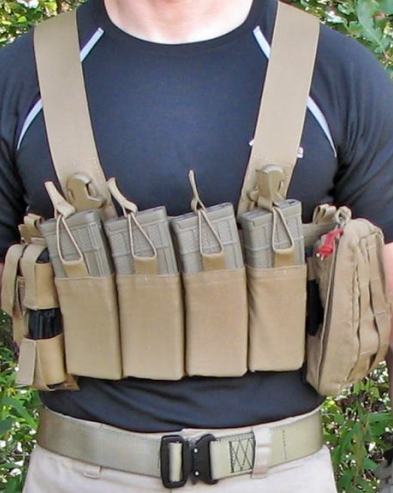
Set this way, the rig does not hang low enough to interfere with a belt and does not wedge under your stomach if you go prone. Equally, it does not sit high enough to slow access to your most important items.
Loading the chest rig
Placement and organization of gear
The most-used items belong within grabbing distance. In a firefight, fresh ammo mags for reloading sit at the very front of the rig. Less-critical gear that does not need to come out in a hurry can go in harder-to-reach pouches.
By laying out gear the same way every time, you train muscle memory. Before long you will blind-reach for items in an instant without taking your eyes off your surroundings.
To minimize bulk, load items as streamlined as possible. Nothing jutting out, nothing dangling. That keeps the gear from hindering movement, distracting you, or impairing marksmanship. Pouches are often detachable, and MOLLE pouches always are. MOLLE-compatible webbing also lets you control horizontal and vertical position of accessories, and feed comms wires or a hydration tube through the straps.
Weight and distribution of gear
Less is more on mass in a chest rig, especially for survival prepping or bugging out. It is fine to leave pouches empty and attachment points unused.
Spread the burden to avoid back strain. You can do that by:
- Stowing the heaviest items as close to your center of mass as possible.
- Splitting items evenly between both sides of the rig.
- Offsetting a front-heavy rig with a small assault backpack of similar weight.
If you are new to chest rigs, break in the rig fully loaded so your posture adapts. Wear it every chance you get until using it becomes second nature.
Which are the best tactical chest rigs?
Whatever your reason for buying, there is a chest rig for every occasion, every level of experience, and every budget. You can browse the full Bulletproof Zone chest rigs collection or pick from the five we keep coming back to, starting with our best seller.
Best Seller chest rig
Warrior Assault Systems Pathfinder Chest Rig

Warrior Assault Systems gear is in service with several of the planet's most elite military and police units. Combat proven, in a word.
Features and specifications
- Slimline H-type harness with fully adjustable shoulder and back strapping.
- 4 open-top fixed bungee-corded inner pockets.
- 2 open-top removable elastic mag pouches with PALS coverage. Easily swapped for any of WAS single, double, or triple stack mag pouches.
- 2 detachable Velcro-flapped rubber-lined utility pouches on either side.
- The PCR works as a modular stand-alone chest rig. It can also be unstrapped and connected via ITW clips and Velcro panel to virtually any plate carrier, including full integration with the Warrior Assault Systems Recon Plate Carrier (RPC), Low Profile Carrier (LPC), or Covert Plate Carrier (CPC) for low or high-viz ops.
- Made from genuine US Military Spec materials and hardware, all treated to give the lowest possible infrared signature (99.8%).
- 500D Cordura with heavy-duty stitching, reinforced in the high-abuse zones.
- Black, Coyote Tan, or, with Murdock webbing, official MultiCam.
- One size fits most.
- Roughly 660 grams (empty).
Best Value chest rig
Condor Modular Chest Set

Thanks in part to a generation of airsofters, Condor Outdoor became the number-one name in entry-level chest rigs. The Modular Chest Set is not the kit you take on a combat tour in the Middle East. But to get a feel for a MOLLE chest rig at a price that does not sting, you cannot go wrong.
Features and specifications
- Sleek harnessless design for max comfort.
- Fully adjustable wide cushioned shoulder straps and waist band for a personalized fit.
- Removable chest bib.
- Strong drag handle set in the uppermost section of the back panel.
- 6 fixed open-top M4 carbine and AR/AK rifle mag pouches, each with bungee elastic loops.
- Internal mesh pocket on each side of the rig for strategic storage.
- Sturdy PALS loops across the shoulder straps, rear pocket, waist band, and front panel.
- Integrated 17-inch tall hydration pocket at the back which holds a 3-liter water bladder (not included).
- 500D tactical nylon material with decent stitching throughout.
- Black, Coyote Brown, Olive Drab, or splurge a little on the genuine Scorpion Operational Camouflage Pattern (OCP).
- Sized M to XXL (waist size of 38" to 55").
- Weighs a touch under 1.4 lb (without load).
Related models
Although not as generously featured, even better value-for-money are the Condor Modular Chest Panel and Condor Modular Chest Rig. Honorable mention also goes to the equally raveworthy Condor Recon Chest Rig (MCR5), which carries 3 kangaroo-style mag pouches and holds up to six pistol mags.

Best Premium chest rig
Haley Strategic D3CRX Chest Rig

Also known as the Disruptive Environments Chest Rig X, the expedition-type D3CRX is "designed and optimized for work in urban, vehicle, rural and other confined settings." A less-civilian and more-professional grade rig adopted by armed forces and Special Weapons And Tactics (SWAT) units on deployment. This particular model even shows up in Escape from Tarkov.
Features and specifications
- Detachable X-type harness.
- 4 rifle mag pouches sized for 5.56 AR, AK 7.62x39 mm, or 5.45x39 mags.
- 4 pistol mag pouches.
- All 8 mag pouches secure with shock cord and Hypalon retention tabs.
- A pair of Multi-Mission large pockets flanking the mag pouches.
- The D3CR-X works as a stand-alone rig, or runs over a plate carrier using either the placard's full hook-and-loop backing field or the matching quick-connect system (such as SwiftClips).
- 500D Cordura with reinforced stitching in the high-abuse zones.
- Black, Coyote, Disruptive Gray, MultiCam, Ranger Green, MultiCam Black, MultiCam Arid, MultiCam Tropic, or M81 Woodland.
- Universal sizing.
- Around 1.5 lb (empty).
Related models
The D3CRXH (Disruptive Environments Chest Rig X Heavy) is an upgraded version of the D3CR X with support for nearly any .308 caliber rifle mag.
Best Minimalist chest rig
Blue Force Gear Ten-Speed M4 Chest Rig

The uber-slender Ten-Speed M4 is for those after a concealable chest rig. Even loaded up, it sits discreetly under loose-fitting clothing without printing on the garment. It works just as well overtly on top of body armor. Like all Blue Force Gear merch, the Ten-Speed M4 ships with a lifetime warranty on the construction.
Features and specifications
- Ergonomic H-style harness with very adjustable wide shoulder and back straps.
- The connecting rear strap doubles as a drag handle.
- 4 sewn-in Ten-Speed mag pouches that rest almost flat against the rig when unloaded.
- 2 wings flanking the front pouches, each with a 3x3 PALS grid for pistol-mag pouches or utility pouches.
- Pull tabs at the top of the placard for quick access to an 18"x6" inside hook-and-loop document pocket.
- 500D Cordura backing fabric.
- Each Ten-Speed pouch uses Blue Force Gear's ULTRAcomp laminate for exceptional retention. ULTRAcomp also sheds liquids, is flame resistant, and self-extinguishes if it catches fire.
- Black or MultiCam.
- Single size fits a wide variety of users.
- A mere 0.7 lb unloaded, narrowly missing the title of world's lightest chest rig held by the Blue Force Gear MOLLEminus.
Best Micro chest rig
Helikon-Tex Training Mini Rig

From Helikon-Tex's RANGE line, the TMR is a true all-rounder. Designed particularly for competitive and recreational shooters, but no less capable for those who aim to use the rig for a "fighting load."
Features and specifications
- H-harness with detachable, adjustable shoulder straps and hip belt, plus Woojin Plastic composite buckles.
- 4 AK/AR rifle mag pouches (2 built-in and 2 removable), each with bungee retention.
- 4 fixed pistol mag pouches with Velcro-secured flaps and adjustable position markers.
- Front-and-center, a large zippered cargo pouch with an internal organizer and mesh pocket.
- A slightly smaller removable zippered accessory pouch underneath.
- Hook-and-loop mesh pocket behind the main pouch.
- A scattering of PALS attachment straps.
- 3 Velcro patches for morale patches or MOLLE gear.
- 500D Cordura with reinforced stitching in places.
- Black, Olive Green, US Woodland, Coyote, Adaptive Green, Flecktarn, MultiCam, Shadow Gray, A-TACS FG, Pencott Wildwood, Black/Shadow Gray, Coyote/Olive Green, or Shadow Gray/Black.
- One size fits most body types.
- 622 grams.
Best Recce chest rig
Blackhawk S.T.R.I.K.E. Commando Recon Chest Harness

An earlier form of Blackhawk's iconic Commando rig was worn by many a Western military contractor during the War on Terror campaign. This iteration stems from the United States Navy SEAL Commando Chest Harness and is in use with US Army and Marine Corps special forces squads.
Features and specifications
- Wearable as either an H-strap or X-strap harness.
- Broad fully adjustable waist and shoulder straps with closed-cell foam padding for comfort.
- Almost the entire rig is covered in Blackhawk's Soldier Tactical Retro Integrated Kit Enhanced webbing system. With virtually no space between attachment strips, users can lash on just about any S.T.R.I.K.E. or MOLLE add-on.
- The front chest panel houses a pocket that accepts a single Small Arms Protective Insert (SAPI) plate up to 10.5" x 13.25" (sold separately).
- Without a ballistic plate in place, the pocket holds paperwork.
- Heavy-duty tactical nylon with stitching that is stout and reinforced where it counts.
- Black or MultiCam.
- Regular size fits girths up to 50".
- Approximately 1.5 lb (empty).
What are the alternatives to a chest rig?
Chest rigs are not the only option for hauling tac gear in the field. Outside of stuffing tactical odds and ends into trouser or jacket pockets, the alternatives are:
- Bandoliers.
- Battle belts (with or without suspenders).
- Carrier bags.
- Fanny packs.
- Leg rigs.
- Rucksacks and sling packs.
Each has its virtues and shortcomings, and they are sometimes worn in combination with a chest rig. A chest rig carries more than a bandoleer, combat belt, thigh rig, or waist pouch, and gives faster access to items than a pack or bag. Plate carriers are also engineered to carry load. Plus, they provide ballistic and stab/spike protection, which begs the question.
What is the difference between a chest rig and a plate carrier?
The clue is in the name. Plate carriers hold hard armor inserts made of steel, ceramic, or polyethylene. Worn with the plates at the front, usually the back, and sometimes the sides, their purpose is to safeguard the wearer's life. Chest rigs, by contrast, are designed expressly for load bearing and that is it.
So which one should you get?
When the threat of a physical attack is likely (and stealth less of a concern), plate carriers are the order of business. When direct action is not the priority but reaction and response time is, chest rigs worn on their own do the job. Chest rigs and plate carriers are not necessarily mutually exclusive. In armed forces and law enforcement (especially when incoming fire is expected), the two are often twinned. You can throw the rig over the plate carrier or, via a Velcro backing panel and corresponding clip system, dock the rig directly to the plate carrier. For a deeper walk-through of either configuration, see our chest rig setup guide.
Frequently Asked Questions
What is the best chest rig for civilians in 2026?
For most civilian shooters, the Warrior Assault Systems Pathfinder and the Haley Strategic D3CRX are the standouts. The Pathfinder is a 660 g H-harness 500D Cordura combat-grade rig that works as a stand-alone or docks to a Warrior plate carrier via ITW clips. The D3CRX uses an X-harness, fits 8 total mag pouches, and is field-issued by SWAT units. Under $90, the Condor Modular Chest Set is the standard entry-level pick.
Is a chest rig better than a plate carrier?
They solve different problems. A chest rig carries load only and weighs roughly 0.7 to 1.5 lb empty. A plate carrier carries load and accepts hard armor plates, weighing 4 to 8 lb before plates and 12 to 18 lb after. Use a chest rig when reaction speed and mobility matter more than ballistic protection. Use a plate carrier when an incoming threat is expected. Many users run both, with the rig docking onto the plate carrier via Velcro or quick-connect clips.
What weight should a chest rig be?
Most well-designed civilian chest rigs weigh 0.7 to 1.5 lb empty. The Blue Force Gear Ten-Speed M4 sits at 0.7 lb, the Warrior Pathfinder at 660 g (about 1.45 lb), the Helikon-Tex Training Mini Rig at 622 g, and the Haley D3CRX at around 1.5 lb. Loaded weight will be considerably higher with mags, comms, and a first-aid kit. Aim for under 10 lb total with load to keep the rig out of the way on level ground.
What size mag pouches do most chest rigs use?
Standard rifle mag pouches accept 5.56x45 mm (M4/AR-15), 7.62x39 mm (AK), or 5.45x39 mm magazines. Pistol mag pouches accept the double-stack 9 mm and .40 S&W. The Haley D3CRX, Helikon-Tex TMR, and Condor Modular Chest Set all carry 4 to 6 rifle mags plus additional pistol mags. The Blue Force Gear Ten-Speed M4 holds 4 rifle mags in sewn-in elastic pouches that lay flat when empty.
Can you wear a chest rig over body armor?
Yes. Most chest rigs are designed to wear over a soft armor vest or a plate carrier. A few rigs go further: the Warrior Pathfinder docks directly to the WAS Recon, LPC, or Covert Plate Carrier via ITW clips and a Velcro panel. The Haley D3CRX uses either a full-backing hook-and-loop field or a SwiftClips quick-connect system to mount onto a plate carrier. The Blackhawk S.T.R.I.K.E. Commando even has a built-in 10.5"x13.25" SAPI plate pocket.
What is the difference between an H-harness and an X-harness chest rig?
An H-harness uses two separate shoulder straps connected at the back by a horizontal cross strip that often doubles as a drag handle. It carries more weight comfortably and is easier to don and doff. An X-harness uses crossing shoulder straps that meet between the shoulder blades. It hugs smaller frames better and is more comfortable for long wear, but tends to ride up when running. Most combat-grade rigs default to H-harness; concealable and lower-profile rigs lean X.
Are chest rigs legal to own?
Yes, in all 50 US states for non-felons. Chest rigs themselves are load-bearing equipment and are not regulated. The body armor that some chest rigs accept (notably the Blackhawk S.T.R.I.K.E. Commando and rigs that dock to plate carriers) is regulated under federal 18 U.S.C. § 931 (felon prohibition) and stricter state law in New York and Connecticut. Bulletproof Zone does not ship body armor to NY or CT consumer addresses.
Key takeaways:
- For most civilians, a 500D Cordura H-harness rig around 1 to 1.5 lb empty with at least four rifle mag pouches and PALS expansion is the right starting point.
- The Warrior Pathfinder is the combat-grade pick (660 g, ITW clips, docks to WAS plate carriers). The Condor Modular Chest Set is the best entry-level rig under $90.
- For premium use, the Haley Strategic D3CRX (8 mag pouches, SWAT field issue). For minimalism, the Blue Force Gear Ten-Speed M4 (0.7 lb, ULTRAcomp laminate).
- H-harness for heavier loads and easier doffing. X-harness for smaller frames and longer wear comfort.
- Chest rigs and plate carriers solve different problems. Run both (rig over carrier) when ballistic protection and reaction speed both matter.
Disclaimer: This article is for informational purposes only and does not constitute legal advice. Body armor laws change at both federal and state levels; consult a licensed attorney in your jurisdiction before relying on any information presented here. Bulletproof Zone makes no claim that body armor will provide complete protection in any scenario; no body armor is bulletproof. Last reviewed: April 2026.
Federal law (18 U.S.C. § 931) prohibits possession of body armor by anyone convicted of a violent felony. State restrictions vary; New York and Connecticut have the most stringent civilian-purchase restrictions. Bulletproof Zone does not ship body armor to New York or Connecticut consumer addresses. Pending litigation (Heeter v. James, W.D.N.Y. 1:24-cv-00623) may alter New York's regulatory landscape; the case is in summary judgment briefing through end of June 2026.
Product specifications referenced in this article are based on each manufacturer's stated specifications at time of publication. Bulletproof Zone is a multi-brand retailer; product availability and configurations may change. Verify current product details on the relevant product page before purchase.