


MOLLE Acronym & System Explained (2026 Guide)

Quick answer: MOLLE stands for Modular Lightweight Load-carrying Equipment. It is a US military gear-attachment standard that uses PALS (Pouch Attachment Ladder System) webbing, rows of 1-inch nylon spaced 1.5 inches apart, to let you attach and reposition pouches, medical kits, and accessories on vests, backpacks, and plate carriers without tools.
If you've ever tried to add a mag pouch to a plate carrier and found yourself staring at rows of nylon webbing, wondering what any of it means, here's everything you need to know. MOLLE is the system. PALS is the physical webbing. The two terms get used interchangeably in the field, which causes confusion, so we'll be specific throughout.
What does MOLLE stand for?
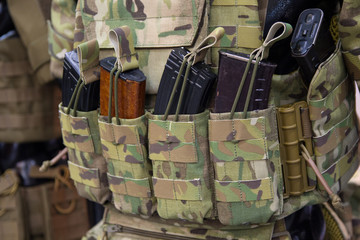
MOLLE is an acronym for Modular Lightweight Load-carrying Equipment. The US Army adopted it in 1997 as a replacement for the older ALICE (All-Purpose Lightweight Individual Carrying Equipment) system. The core idea: instead of fixed pockets sewn at fixed positions, soldiers could reconfigure their loadout based on the mission. A rifleman's chest rig looks nothing like a medic's, even though both might start with the same base vest.
NATO allies, primarily British and American troops, standardized on MOLLE webbing early. By the mid-2000s it had crossed into law enforcement, then into civilian plate carrier and backpack design. Today you'll find PALS webbing on everything from range bags to hiking packs to children's school bags marketed as "tactical." Not all of that is useful. More on that below.

How does MOLLE work?
The physical substrate is PALS webbing: rows of 1-inch-wide nylon fabric stitched horizontally across a backing panel, with each row spaced 1.5 inches from the next. Vertical stitching at every 1.5 inches creates the "ladder" grid. A standard MOLLE pouch has matching woven straps on its back that weave through those rows to lock the pouch in place.
The webbing is typically 1000D Cordura nylon on quality gear, 600D on budget variants. You'll feel the difference after a year of use. The stitching that holds the horizontal rows down is load-bearing; on cheaper construction, that's the first thing to fail. I had a Condor pouch separate at the weld point during a three-day carbine course in central Texas in July 2024, about 200 repetitions into the draw cycle. The pouch itself was fine; the attachment row had delaminated from the base panel at the heat-seal rather than a proper box-X stitch. It's the kind of thing you find out under use, not by looking at it on a shelf.

The MOLLE standard specifies 1-inch webbing at 1.5-inch row spacing. Any pouch or accessory built to that spec will fit any PALS-webbed carrier, backpack, or vest. That cross-compatibility is the whole point. Your HSGI Taco mag pouch will seat the same way on a Ferro Concepts carrier as on a Mystery Ranch pack.
How does MOLLE compare to ALICE?
ALICE used metal clips and a fixed-loop webbing pattern. It worked reliably in its era, but reconfiguring a loadout meant physically re-routing hardware through eyelets, which is slow under field conditions. MOLLE's woven-strap attachment takes maybe 90 seconds per pouch once you know what you're doing, compared to 5-plus minutes for ALICE hardware.

ALICE gear was also built around fixed-frame external packs that distributed weight through the frame rather than the carrier. MOLLE systems, especially chest rigs and plate carriers, shift weight distribution to MOLLE-compatible load-spreading across the torso. The tradeoff is real: an ALICE pack with a good frame beats a fully loaded MOLLE chest rig for multi-day wilderness carries over 50 lbs. For everything under 30 lbs of tactical kit, MOLLE wins on reconfigurability.
Sgt. 1st Class Adam Klakowicz, writing for Task & Purpose after two decades in the Army including time as a Green Beret, specifically praised MOLLE's adaptability in winter and mountain terrain where loadout requirements shift daily. His experience lines up with what most LE and military users report: the reconfigurability matters more than the weight savings.
How do you attach MOLLE pouches?

MOLLE attachments use woven straps on the back of the pouch that thread through the carrier's PALS webbing in an alternating pattern. The process:
- Count the rows on your carrier and the straps on your pouch. A standard single-mag pouch uses 2 straps spanning 2 rows; a larger admin pouch might use 3 straps across 3 rows.
- Thread the first strap over the carrier's top row, under the second row, over the third (alternating). Pull snug.
- Snap or fold the end of the strap to secure it. Better pouches use a G-hook or snap closure; budget pouches use a folded tab that works loose over time.
- Repeat for each strap, keeping vertical alignment consistent so the pouch sits flat.
A few things worth knowing: threading both straps simultaneously (one in each hand) is faster than doing them sequentially. And if a pouch feels even slightly loose after seating, it is loose. Under draw-repetition or a hard fall, a half-seated pouch rotates and dumps its contents. Snug means the strap has no slack when you try to slide it side-to-side.
Some carriers, including several Shellback Tactical and Ferro Concepts models, use laser-cut MOLLE rather than stitched webbing. The slots are cleaner and lighter, but the attachment process is identical.
What are the real-world benefits of MOLLE?
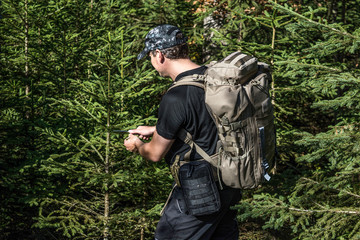
Cross-compatibility is the most underrated benefit. The same HSGI Taco pouch you run on your plate carrier mounts to your range bag, your vehicle headrest MOLLE panel, or your hiking pack without modification. You buy a good pouch once and it follows your kit. Budget carriers with proprietary attachment systems trap you into buying that brand's accessories, or cutting and re-sewing webbing when you upgrade the carrier.
Weight distribution is second. A well-configured MOLLE loadout keeps heavy items (extra mags, trauma kit) centered on the torso and close to the body, which reduces the lever-arm effect that causes fatigue over time. A MOLLE IFAK on the non-dominant side at about the 8 o'clock position, immediately behind the pistol mag pouch, is the TCCC-standard placement because it's reachable with either hand and doesn't interfere with shouldering a long gun.
One honest caveat: MOLLE adds bulk and snag points. A fully loaded carrier with 6 mag pouches, an admin pouch, and an IFAK is not a low-profile option. If you're looking at concealable soft armor (Level IIIA / HG2) for daily carry, that's a different category entirely; see Bulletproof Zone's guide to NIJ protection levels for where plate carrier systems fit in the threat-level picture.
Who uses MOLLE?

Military and law enforcement are the core users, and not just in the US. UK armed forces, Canadian military, and most NATO allies adopted PALS-compatible systems after the late 1990s. American and British LE agencies moved to MOLLE plate carriers and tactical vests extensively through the 2000s and 2010s.
Beyond uniformed use, MOLLE shows up in three civilian categories that actually make sense:
- Competitive shooters and range regulars who want repeatable, reconfigurable kit. A MOLLE-based range bag means your ammo, tourniquet, and eye/ear protection are always in the same spot.
- Hunters, backcountry hikers, and overlanders who want to add external pouches to a pack without a sewn modification. A MOLLE panel on a vehicle roll bar, for instance, holds a trauma kit accessible from the driver's seat.
- Emergency preparedness builds. Bug-out bags with PALS webbing let you attach a blow-out kit, a multi-tool pouch, and a water filter holder without re-packing the main compartment every time your kit evolves.

Where MOLLE does not add value: purely casual carry, urban daily commuter bags, or any situation where snag points and visual bulk are a liability. Condor sells a lot of MOLLE-covered everything, and some of it is useful. But MOLLE webbing on a laptop bag is mostly aesthetic. If the pouches aren't going to move and the gear isn't tactical, a regular zipper pouch is lighter and simpler.
Bulletproof Zone carries MOLLE-compatible plate carriers, MOLLE pouches, and individual accessories from brands including Shellback Tactical, Blackhawk, Ace Link Armor, and Tacticon Armament. Browse the full MOLLE collection or the broader tactical accessories catalog if you're building out a loadout from scratch.
Frequently Asked Questions
What does MOLLE stand for?
MOLLE stands for Modular Lightweight Load-carrying Equipment. It is a US Army standard adopted in 1997 for modular gear attachment. The physical attachment system it uses is called PALS (Pouch Attachment Ladder System), which consists of rows of 1-inch nylon webbing spaced 1.5 inches apart.
What is the difference between MOLLE and PALS?
MOLLE is the overall system name and doctrine; PALS is the specific webbing specification that makes it work. Think of MOLLE as the standard and PALS as the hardware. Most gear is labeled "MOLLE compatible" when it technically means "PALS webbing compatible." In practice, the terms are used interchangeably by most manufacturers and users.
Is all MOLLE gear the same quality?
No. Quality ranges from 1000D Cordura with box-X stitching (found on US military-issue and brands like Ferro Concepts, HSGI, and Spiritus Systems) to 600D polyester with heat-sealed attachment rows (common in budget brands like Condor at the lower end of their line). The attachment-row stitching is where budget gear fails first, usually within 1,000 draw cycles under load. For kit you train with regularly, buy the better webbing once.
Can civilians buy MOLLE gear?
Yes, without restriction in all 50 US states. MOLLE plate carriers, pouches, and accessories are sold openly to civilians. The armor plates or soft armor you might put inside a MOLLE plate carrier are regulated by state law (notably New York and Connecticut have civilian purchase restrictions), but the carrier itself is unregulated consumer goods.
How do you attach pouches to MOLLE webbing?
Thread the pouch's attachment straps through the carrier's PALS rows in an alternating over-under pattern, then snap or fold the strap ends to secure. Start at the top row, alternate over and under with each subsequent row, and pull snug before securing. A properly seated pouch cannot slide side-to-side when you push it with moderate hand pressure.
What is the difference between MOLLE and ALICE?
ALICE (All-Purpose Lightweight Individual Carrying Equipment) is the system MOLLE replaced in the late 1990s. ALICE used metal clips and fixed webbing loops; MOLLE uses woven straps through PALS webbing rows. MOLLE is faster to reconfigure, more compatible with modern armor systems, and distributes weight better across a plate carrier. ALICE pack frames still have advocates for multi-day wilderness carries over 50 lbs.
Does MOLLE work with all plate carriers?
Any carrier with PALS-spec webbing (1-inch rows at 1.5-inch spacing) accepts standard MOLLE accessories. Some newer carriers use laser-cut MOLLE slots rather than stitched webbing; the attachment process is identical. Non-PALS proprietary attachment systems (a few budget carriers use them) are not MOLLE compatible, even if they look similar.
Key takeaways:
- MOLLE stands for Modular Lightweight Load-carrying Equipment; the physical webbing it uses is called PALS (Pouch Attachment Ladder System), with rows of 1-inch nylon at 1.5-inch spacing.
- The system lets you attach, remove, and reposition pouches on any PALS-webbed carrier, backpack, or vest without tools, in under 2 minutes per pouch.
- Quality varies significantly: look for box-X stitching and 1000D Cordura on gear you'll train with; heat-sealed budget webbing fails at the attachment row under repetitive use.
- MOLLE is unrestricted for civilian purchase. The body armor that goes inside a MOLLE plate carrier is subject to state law; the carrier hardware itself is not.
- Cross-compatibility is the main value: a good HSGI or MOLLE-spec pouch follows your kit from carrier to carrier and does not lock you into one brand's ecosystem.
Disclaimer: This article is for informational purposes only and does not, and is not intended to, constitute legal advice. Bulletproof Zone makes no claim that body armor will provide complete protection in any scenario; no body armor is bulletproof. Product specifications referenced in this article are based on manufacturer stated specifications at time of publication. Bulletproof Zone is a multi-brand retailer; product availability and configurations may change. Verify current product details on the relevant product page before purchase.