


NIJ Protection Levels: What Does Level IIIA Stop? (2026)

Quick answer: NIJ Level IIIA soft armor stops .357 SIG and .44 Magnum at 1,470 ft/s and every common handgun caliber below it. It does not stop rifle rounds. For 5.56 NATO or 7.62x51 you need NIJ Level III (RF1 under the new NIJ 0101.07 nomenclature) or higher. Level IIA is being retired. The current naming under NIJ 0101.07 is HG1, HG2, RF1, RF2, and RF3.
Threat levels for ballistic vests are set by the National Institute of Justice. The active framework as of April 2026 is NIJ Standard 0101.06 (2008), with the successor NIJ 0101.07 published November 29, 2023. The .06 Compliant Products List was closed to new applications January 5, 2024 and final adjudications completed February 2025, but the .06 CPL itself is maintained through at least end of CY 2027. No products are listed on a 0101.07 CPL as of April 2026 because the CPL has not yet been published.
That gap matters when you're reading product copy. A vendor claiming "NIJ 0101.07 certified" today is making a statement no manufacturer can legally back up. The defensible phrasing for new gear is "designed to meet NIJ 0101.07 [HG/RF]X threat profile" or "independently tested to 0101.07 test parameters at [named lab]." Anything stronger is FTC exposure under 16 CFR Part 255 § 255.4.
NATIONAL INSTITUTE OF JUSTICE (NIJ) PROTECTION LEVELS
The NIJ was formed in 1968 as the research arm of the Department of Justice. It isn't a regulator, and it doesn't "certify" body armor in the sense most buyers use that word. What NIJ actually does is publish performance standards (currently 0101.06, transitioning to 0101.07) and maintain the Compliant Products List. A vest is "NIJ Listed" when its make, model, and serial range appear on the CPL after passing testing at an NIJ-approved lab. "Independently tested to NIJ parameters" is a weaker but still useful claim: it means a named lab ran the test, but the model hasn't been adjudicated onto the CPL.
The chart below covers what each level under 0101.06 defends against. We'll walk through each level individually, then map them to the new 0101.07 names.

Each level protects against its own threat range and every level below it. Level IIIA stops everything Level II and IIA stop. Level III stops every handgun round Level IIIA stops, plus 7.62x51 NATO ball. Level IV stops the 7.62 mm M2 armor-piercing round — but only for one hit, not the multi-hit guarantee you get with Level III.
NIJ LEVEL I BODY ARMOR
Obsolete since the 1980s.
Level I was the original 1972 NIJ rating, retired roughly forty years ago. If you see a vest sold today as "Level I," it's either decades-old surplus or fraudulent. Skip it.
NIJ LEVEL IIA BODY ARMOR
The lowest still-tested .06 level. Eliminated under 0101.07.
Level IIA is soft armor rated for 9 mm at 1,165 ft/s and .40 S&W at 1,065 ft/s. It's the lightest, most concealable rating in the 0101.06 framework, but it's being retired under 0101.07. The new standard collapses IIA and II into a single handgun tier (HG1).
LEVEL IIA PROTECTS AGAINST:
- 9 mm FMJ RN at 1,165 ft/s
- .40 S&W FMJ at 1,065 ft/s
Practical recommendation: skip IIA and go to Level II at minimum. The weight difference is roughly half a pound on a typical concealable carrier, and IIA disappears from the catalog as 0101.07 adoption proceeds.
NIJ LEVEL II BODY ARMOR
Handgun armor that defeats up to .357 Magnum.
Level II soft armor stops 9 mm at 1,305 ft/s and .357 Magnum JSP at 1,430 ft/s. Materials are typically Kevlar, Twaron, or Dyneema in a multi-layer ballistic panel. Under NIJ 0101.07 this rating maps to HG1.
LEVEL II PROTECTS AGAINST:
- 9 mm FMJ RN at 1,305 ft/s
- .357 Magnum jacketed soft point at 1,430 ft/s
Use case: low-threat patrol, plainclothes work, or civilian concealable wear in environments where a long-gun encounter isn't on the realistic threat list.
Featured Level II armor from our collection:
Blade Runner Lightweight Stab proof / Bulletproof Vest

NIJ LEVEL IIIA BODY ARMOR
The civilian default for concealable soft armor.
Level IIIA is the workhorse rating for soft body armor. It stops 9 mm at 1,470 ft/s and .44 Magnum SJHP at 1,430 ft/s. Under NIJ 0101.07 the new name is HG2. If you ask law enforcement or military veterans what the lowest sensible civilian level is, they'll almost always say IIIA — and it's a reasonable answer for two reasons: handgun rounds are the realistic threat outside an active shooter event, and IIIA is still light enough to wear under clothing for an eight-hour shift.
LEVEL IIIA PROTECTS AGAINST:
- 9 mm FMJ RN at 1,470 ft/s
- .44 Magnum SJHP at 1,430 ft/s
- All threats covered by Level II and IIA
What IIIA does not stop: 5.56 NATO (M193 or M855), 7.62x39, 7.62x51, FN 5.7, or any centerfire rifle round. It also won't stop 9 mm Civil Defense or shotgun slugs at close range, even though those are nominally handgun-class. Several manufacturers sell "IIIA+" pouches and panels that have been independently lab-tested against those edge-case threats. Worth knowing: "+" ratings (IIIA+, III+) are manufacturer designations and are not part of NIJ Standard 0101.06 or 0101.07 nomenclature.
Materials are typically Kevlar, Twaron, or ultra-high-molecular-weight polyethylene (UHMWPE). UHMWPE panels are roughly 30% lighter than aramid for the same threat rating but cost more.
Featured Level IIIA armor from our collection:
ProtectVest 10"x12" Level IIIA Bulletproof Vest

LEVEL IIIA+ (MANUFACTURER DESIGNATION)
Some vendors sell IIIA+ panels rated against shotgun slug, 9 mm Civil Defense, and FN 5.7 in addition to standard IIIA threats. IIIA+ is not an NIJ designation. It indicates extended in-house or independent lab testing beyond the 0101.06 IIIA test set. Treat IIIA+ claims the way you'd treat aftermarket performance numbers on a car — read the lab report, and confirm the testing facility is on the NIJ-approved list.
NIJ LEVEL III BODY ARMOR
The first rifle-rated level. RF1 under 0101.07.
Level III is the first rating that defends against rifle rounds. Hard plates, not soft panels. Under NIJ 0101.07 the equivalent name is RF1. Level III is rated for six shots of 7.62x51 NATO M80 ball at 2,780 ft/s on a single plate.
LEVEL III IS DESIGNED TO HANDLE:
- 6 shots of 7.62x51 NATO M80 ball at 2,780 ft/s
- All handgun threats from IIIA and below
Level III plate materials are typically ceramic, polyethylene (UHMWPE), steel, or a composite. Steel plates are cheapest and heaviest at 6 to 10 lb each. UHMWPE is lightest, often 3 lb, floats in water, but degrades faster in heat above 150°F. Ceramic sits in the middle for weight and price but cracks if dropped on concrete; backface deformation is also tighter than the others. Read our hard-armor materials breakdown before choosing.
Coverage gap: Level III as written defeats 7.62x51 M80 ball but isn't rated for 5.56 NATO M855 "green tip" or M193. That's the gap 0101.07 RF2 was designed to fill.
Featured Level III armor from our collection:
Caliber Armor Maritime Armor Level III UHMWPE Plate

LEVEL III+ (MANUFACTURER DESIGNATION)
III+ is not an NIJ rating. The label indicates a Level III plate that has additionally been tested against M855 green-tip and/or M193 5.56 ball at the manufacturer's chosen velocity. The 0101.07 RF2 tier formalizes this with an NIJ-defined M855 test (5.56 M855 at ~3,115 ft/s plus all RF1 threats). Once an RF2 CPL exists, expect most legitimate III+ products to migrate onto it. Until then, ask for the lab report and confirm the lab is NIJ-approved — Chesapeake Testing, NTS Chesapeake, H.P. White, and Oregon Ballistic Laboratories are the usual names. Note: "+" ratings (IIIA+, III+) are manufacturer designations and are not part of NIJ Standard 0101.06 or 0101.07 nomenclature.
Featured Level III+ armor from our collection
Level III+ Body Armor Plates Collection
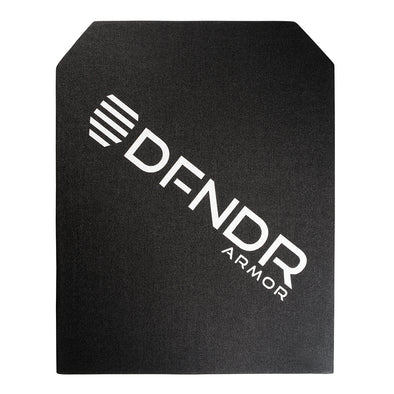
LEVEL IV BODY ARMOR
Top of the .06 stack. RF3 under 0101.07.
Level IV is the highest rating in 0101.06. The test round is a single 7.62 mm M2 AP (armor-piercing) at 2,880 ft/s. Single hit. That last part matters: Level IV is rated for one stop, not the six of Level III. A Level IV plate hit twice in close proximity is not guaranteed to perform.
LEVEL IV IS DESIGNED TO HANDLE:
- 1 hit of 7.62x63 (.30-06) M2 AP at 2,880 ft/s
- All handgun and rifle threats from Level III and below
Materials are typically a ceramic strike face (boron carbide, silicon carbide, or alumina) over a UHMWPE backer. Total plate weight is usually 7 to 8 lb for a single 10x12 SAPI cut. Steel Level IV exists but is rare; the spalling and weight tradeoffs make it uncommon outside fixed-position use.
Here's the catch: Level IV is overkill for most civilian threat models. The test cartridge (.30-06 M2 AP) is essentially a hunting-rifle round loaded with a hardened steel core. If your threat model is urban defense or active-shooter scenarios, Level III or RF2 covers the realistic threat set at less weight and cost.
Featured Level IV armor from our collection:
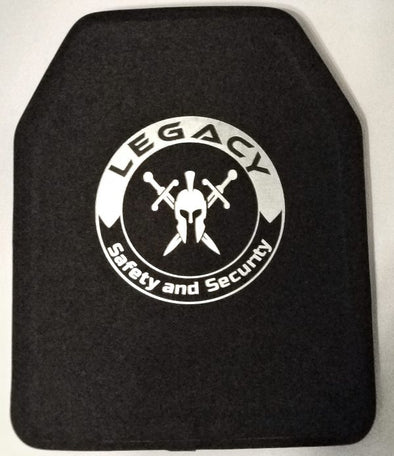
Legacy Lightweight Multi-Hit Level IV Body Armor Plate
NIJ 0101.07 NEW NAMING: HG1, HG2, RF1, RF2, RF3
The new standard published November 29, 2023 abandons Roman-numeral levels for a two-letter category prefix (HG = handgun, RF = rifle) plus a numeric tier. The crosswalk:
- Level IIA → eliminated
- Level II → HG1
- Level IIIA → HG2
- Level III → RF1
- (new tier) → RF2 — defeats 5.56 M855 plus all RF1 threats
- Level IV → RF3
Companion threat-level spec NIJ 0123.00 published the same day. The CPL transition is gradual. Until an 0101.07 CPL is published, the most legally precise vendor claim is "tested to NIJ 0101.07 [tier] test parameters at [named NIJ-approved lab]." For our coverage of the new standard, see NIJ Standard 0101.07: What the New Body Armor Levels Mean.
SPECIAL LEVEL ARMOR
"Special threat" or "special type" armor describes vests tested against threats outside the standard NIJ test set. Level IIIA+ and III+ both fall under this umbrella, as do plates rated against specific civilian threats vendors expect their customers to face — M193 5.56 ball, certain green-tip lots, FN 5.7, shotgun slugs. Special-threat ratings always carry a specific caliber and velocity callout. Read those numbers, not just the tier label.
BODY ARMOR LEVEL FAQS
Does Level IIIA stop a 5.56 NATO round?
No. Level IIIA is rated for handgun threats only, up to .44 Magnum at 1,430 ft/s. 5.56 NATO travels at roughly 3,000 ft/s and will pass through every IIIA panel ever sold. To stop 5.56 you need at minimum a Level III hard plate — and ideally a III+ or RF2 plate, since standard Level III isn't specified against 5.56 M855.
Is Level IIIA bulletproof?
No body armor is bulletproof. The accurate term is bullet-resistant. Level IIIA is rated to defeat the handgun threats listed in NIJ 0101.06 (9 mm at 1,470 ft/s, .44 Magnum at 1,430 ft/s) and every lower threat. It's not rated against rifle rounds or against handgun rounds above its tested velocity. Backface deformation — the depth of the dent left in the panel after a hit — is also regulated; even a "stopped" round can cause blunt trauma injury.
Level IIIA vs Level III: which do I need?
IIIA is soft and concealable and stops handgun rounds. Level III is hard and overt and stops 7.62x51 NATO ball. The right choice depends on your realistic threat: a security guard or off-duty officer in a low-rifle environment is well-served by IIIA; anyone planning for a long-gun encounter needs III or higher. IIIA can also be worn ICW (in conjunction with) a III plate as a soft backer for additional fragmentation protection.
What does the "+" mean in IIIA+ and III+?
The "+" is a manufacturer designation, not an NIJ rating. It means the vendor or an independent lab has tested the armor against threats outside the standard NIJ test set — typically 5.56 M193 or M855 for III+, and shotgun slug or FN 5.7 for IIIA+. Ask for the lab report and verify the testing lab is NIJ-approved.
How often does NIJ update the protection level standards?
Roughly every 8 to 15 years. The current 0101.06 standard published in 2008. Its successor, 0101.07, published November 29, 2023 alongside the companion threat spec NIJ 0123.00. The 0101.06 CPL is closed to new applications as of January 5, 2024 and final adjudications completed February 2025, but the existing CPL is maintained through end of CY 2027. The 0101.07 CPL has not yet been published as of April 2026.
Can I stack two Level IIIA panels to upgrade to Level III?
No. Stacking soft panels doesn't produce hard-armor performance. IIIA panels are designed for handgun threats; rifle rounds cut through aramid and UHMWPE soft armor regardless of how many layers are stacked. The legitimate ICW configuration is a Level IIIA soft panel behind a Level III or IV hard plate, where the soft panel catches fragmentation and reduces backface deformation. That combination is sometimes ICW-listed on the CPL for specific plate and panel pairings.
How are stab-proof and spike-proof vests rated?
Stab and spike-proof vests are tested under NIJ Standard 0115.00, a separate framework from ballistic 0101.06. Ratings are by impact energy in joules: Level 1 (24 J), Level 2 (33 J), Level 3 (43 J). Ballistic vests are not stab-rated by default and vice versa; combination vests exist but are heavier than either alone.

WHAT SHOULD I KNOW ABOUT NIJ STANDARDS?

Three things matter when you're reading an NIJ claim. First, what level and which standard (0101.06 or 0101.07). Second, whether the product is "NIJ Listed" on the CPL or "independently tested to NIJ parameters" — the former is the stronger claim. Third, the named test lab. Chesapeake Testing, NTS Chesapeake, H.P. White Laboratory, and Oregon Ballistic Laboratories are the most common NIJ-approved facilities. A claim that doesn't name a lab is a claim you can't verify.
The highest rating isn't always the right rating. A IIIA soft panel weighs roughly 2 to 3 lb and conceals under a button-down shirt. A Level IV plate weighs 7 to 8 lb and is overt over a plate carrier. If you're buying for daily wear in a low-rifle threat environment, IIIA is the correct choice and Level IV is the wrong one. Match the rating to the realistic threat you face, then work up only if the threat profile genuinely justifies it.
With the new 0101.07 framework rolling out and the .06 CPL closing to new applications, expect catalog churn through 2027 as manufacturers re-test and re-list. If you're buying soft armor today, .06 IIIA listed on the CPL is still the cleanest claim you can get. If you're buying hard plates and the vendor offers an option labeled RF2, ask for the test report and confirm the testing lab.
Browse our full body armor collection, or contact our team if you'd like help matching a rating to your threat model.
Disclaimer: This article describes NIJ ballistic standards in effect as of April 2026 and is general information, not legal or safety advice. Body armor performance is contingent on fit, panel orientation, panel age, exposure history, and the specific threat encountered. Federal law (18 U.S.C. § 931) prohibits possession by anyone convicted of a "crime of violence" felony. Verify the legal status of body armor in your state before purchase. Always train with the gear you carry; a vest you cannot deploy under stress is not protection.