


What Is a Stab Vest? Materials, Standards & Ratings 2026

Quick answer: A stab vest is soft body armor built from tightly woven aramid or UHMWPE fabric designed to stop edged blades and spikes from penetrating the body. Tested under NIJ Standard-0115.00, stab vests are graded at three protection levels (1, 2, 3). Standard bullet-resistant vests do not reliably stop knives; a dedicated stab vest is a separate product category.
A standard bullet-resistant vest will not reliably stop a knife. The mechanics are fundamentally different: a ballistic panel defeats a fast-moving projectile by spreading impact energy across many fiber layers, while a blade concentrates force on a tiny point and slices right between those same fibers. Stab vests solve this with tighter weave geometries and, at higher protection levels, chain-mail or hard-laminate strike faces specifically engineered to catch and redirect an edge.
- Who actually needs a stab vest?
- What materials go into a stab vest?
- How is a stab vest constructed?
- Stab vest vs. bullet-resistant vest vs. spike-proof vest
- What standards and ratings apply to stab vests?
- How do you care for a stab vest?
- What should you look for when buying a stab vest?
- Frequently asked questions
Who actually needs a stab vest?

Stab vests are standard issue for UK and Australian police, prison officers, and court security. In the US, law enforcement officers working in jails, psychiatric units, or close-contact patrol environments often wear stab vests either instead of or layered with ballistic panels. Security guards at nightclubs, cash transit crews, and EMTs responding to weapon-involved calls are other common users.
Civilian buyers are a smaller but real segment. A security consultant I spoke with in London wore a PPSS covert panel under a suit jacket for six months in summer 2025, covering protection assignments where a visible tactical vest would have been operationally disqualifying. His main complaint: the carrier's side adjustment tabs added 3 mm of bulk on the left side and showed through fitted dress shirts. That's the kind of fit problem that only surfaces after weeks of daily wear — not in a five-minute try-on.
Environmental stab threats are a less-discussed use case worth knowing about. Search-and-rescue teams and disaster-relief workers have used stab-rated panels when clearing rubble fields containing broken rebar, metal sheeting, or shattered glass. In those situations the vest isn't worn for protection from other people — it's worn because the terrain itself is sharp.
What materials go into a stab vest?
Like bullet-resistant vests, stab vests depend on high-performance synthetic fibers. The two dominant materials are aramid and UHMWPE.
Aramid is a synthetic fiber with a high strength-to-weight ratio, heat resistance, and cut resistance. It doesn't catch fire at typical ambient temperatures and resists melting. Kevlar is the brand name most buyers recognize; Twaron (Teijin), Technora, and Heracron are functional equivalents used by various manufacturers. Aramid's weakness is UV sensitivity and moisture absorption over time — which is why panels should never be stored wet or left in direct sunlight.
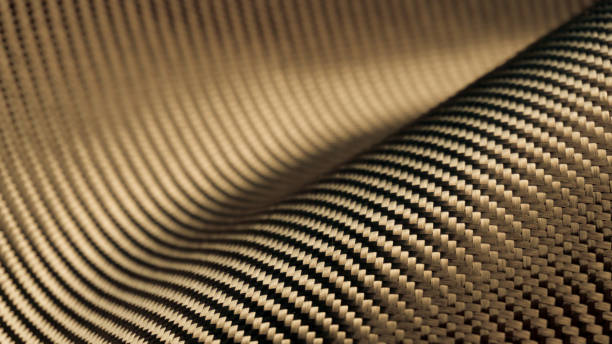
UHMWPE (Ultra High Molecular Weight Polyethylene) is the other mainstream option. At roughly 15 times the strength of steel by weight, UHMWPE panels are lighter than equivalent aramid panels and are water-resistant where aramid is not. The trade-off is a lower melting point, which limits use in high-heat environments. Dyneema (DSM) and Spectra (Honeywell) are the main commercial grades.

Higher-rated stab vests add chain mail, titanium laminates, or rigid carbon-fiber composite plates behind the soft fiber layers. The PPSS Overt vest, for example, uses 3.6 mm Forti-ply carbon fiber composite panels bonded to the soft-armor backer. That laminate is what makes SP1 and KR1 ratings achievable without the vest becoming unreasonably heavy.
How is a stab vest constructed?
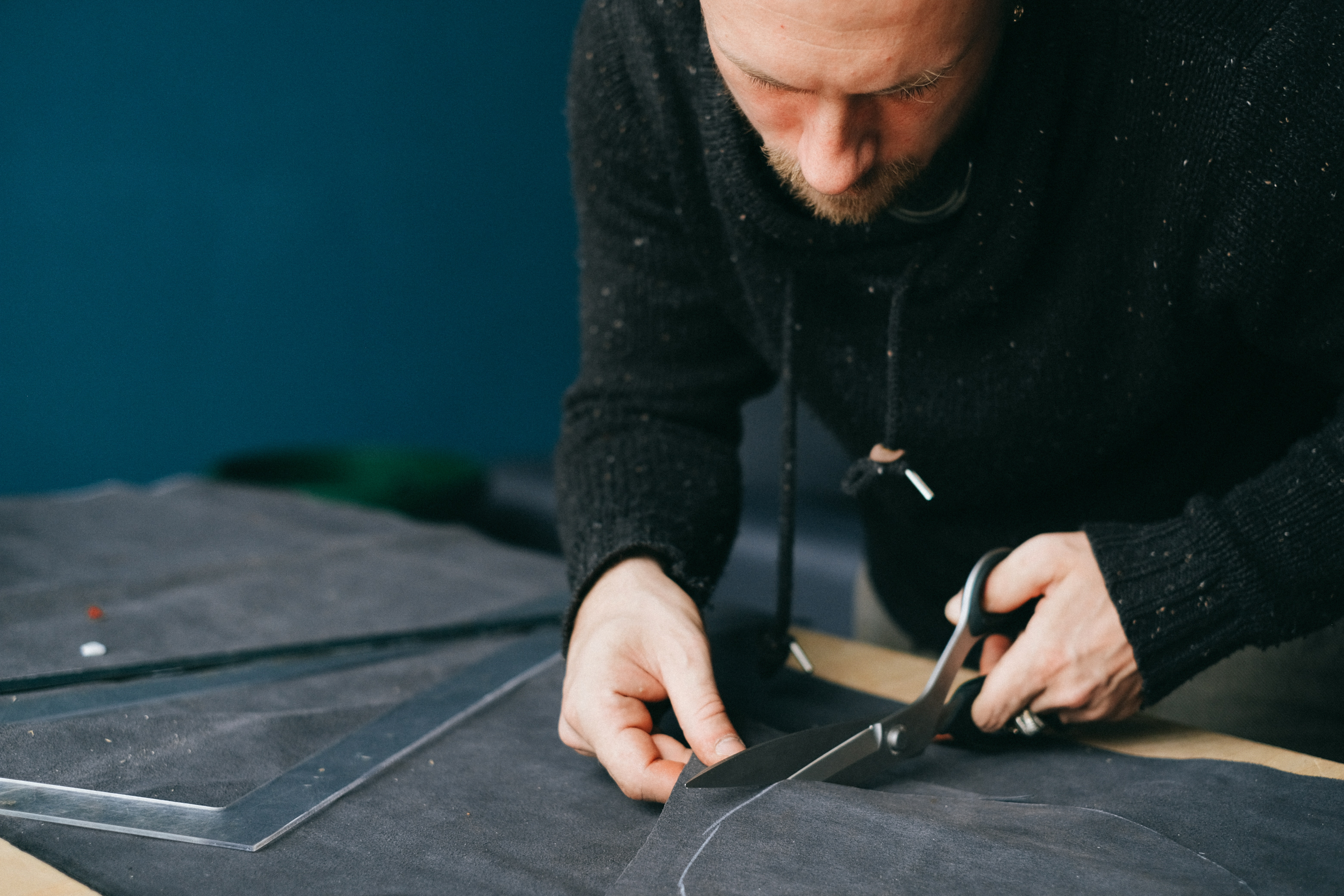
Manufacturing starts with material selection matched to the target protection level. For a Level 1 stab vest, multiple layers of woven aramid or UHMWPE are cut to panel dimensions and stacked. For Level 2 and Level 3, additional laminate layers or a chain-mail strike face are bonded to the stack before the panels are sewn into the carrier.
The panels are inserted into a fabric carrier — typically ballistic nylon or a breathable spacer fabric — which holds them in position while allowing the vest to be worn and adjusted. Finished vests are tested by driving standardized blades and spikes into the panel face at specified energy levels; the panel must prevent penetration beyond defined limits to pass.
Stab vest vs. bullet-resistant vest vs. spike-proof vest: what is the difference?
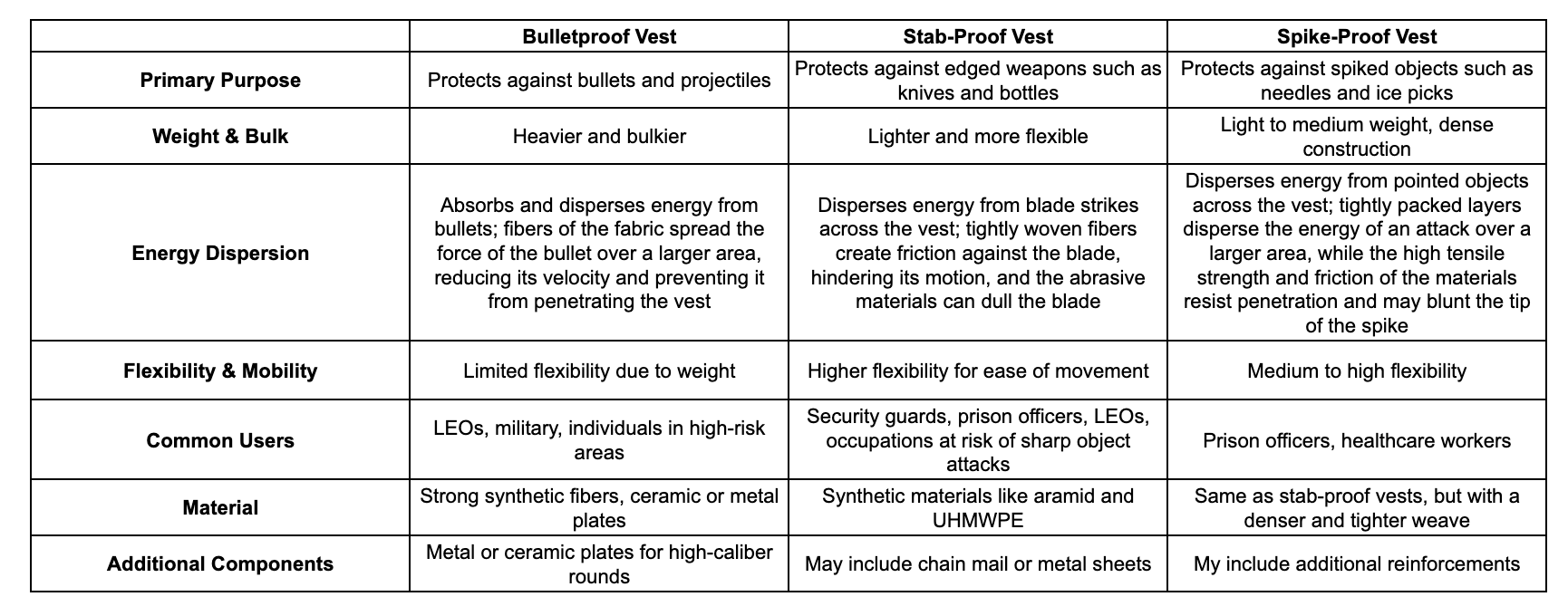
A bullet-resistant vest (NIJ 0101.06 or 0101.07-rated) uses loosely woven high-tenacity fiber that defeats projectiles through energy dispersion. That same loose weave is exactly why a narrow blade can push between the fibers and penetrate. A stab vest uses much tighter weave geometries and, at higher levels, hard laminates that physically block a blade edge.
A spike-proof vest adds protection against pointed instruments — needles, ice picks, filed screwdrivers — that are thin enough to pass through both standard ballistic and standard stab weaves. SP ratings in the NIJ 0115.00 standard address spike threats; KR ratings address edged blades. Many operational vests carry both ratings.
Multi-threat vests combine ballistic protection (NIJ Level II or IIIA under 0101.06) with stab and spike ratings. The SafeGuard Armor Stealth Pro is one of the few concealable options in the Bulletproof Zone catalog that carries both NIJ ballistic and edged-blade ratings, with the buyer choosing protection level at the time of order.

What standards and ratings apply to stab vests?
Two frameworks dominate: NIJ Standard-0115.00 (US) and the UK Home Office Body Armour Standard (2017), maintained by the Centre for Applied Science and Technology (CAST). Because the test methodologies are broadly aligned, a vest that passes one framework typically satisfies the other at the equivalent level.
NIJ Standard-0115.00 classifies stab and spike resistance across three levels for each threat type. The classification image below shows the energy thresholds at each level.

UK CAST Body Armour Standard (2017) uses KR (knife resistance) and SP (spike/puncture) designations with corresponding energy levels. The PPSS Group vests stocked by Bulletproof Zone carry CAST KR1 and SP1 ratings, which map to NIJ Level 1 edged-blade and spike performance.

Here's the catch: when a manufacturer says a vest is "certified," you need to ask which specific standard, which level, and whether an independent accredited lab conducted the testing. Vests sold on general-purpose marketplaces frequently describe themselves as "stab-resistant" without citing a standard or level. That language is meaningless for protection decisions.
How do you care for a stab vest?
The ballistic and stab panels are the irreplaceable part of the vest; the outer carrier is not. Wipe the panels down with a damp cloth if they get dirty. Don't submerge panels in water — prolonged moisture exposure degrades aramid fiber over time, and UHMWPE panels can delaminate if the bonding agent is water-sensitive. The outer carrier can usually be machine-washed on a gentle cycle. Check the manufacturer label, since some carriers include MOLLE webbing or rigid frame components that shouldn't go through a washer.
Air-dry panels flat, away from direct sunlight. UV exposure degrades aramid fiber faster than almost anything else in a typical storage environment. Store the vest flat in a cool, dry space; folding creates permanent creases that reduce panel effectiveness in the folded zone over time.
Inspect the panel surface before each use. Look for fraying at the edges, hard creases, discoloration from chemical exposure, or deformation after an impact event. If the vest has absorbed a stab or spike hit, it needs to be replaced regardless of whether it looks intact — the internal fiber structure may be compromised at the strike point even when the exterior looks fine.
What should you look for when buying a stab vest?

Start with the threat environment, not the price. A security guard working a music venue faces edged-blade threats. A prison officer or probation worker in the UK faces both edged and spike threats from improvised weapons. A US law enforcement officer in a jail setting may face both of those plus a ballistic risk. Choose the NIJ 0115.00 level that matches your specific threat, then verify the manufacturer's test documentation actually supports that claim.
Fit matters more with stab vests than with plate carriers because stab vests are typically worn all shift, often under clothing. A vest that rides up on the torso exposes the lower abdomen; one that shifts sideways reduces front coverage. Adjustable side straps and shoulder straps are the minimum. A vest with a fixed geometry that doesn't adjust at the side panels isn't worth buying for daily operational use.
Skip the cheap options on general-purpose marketplaces. Generic "stab-resistant" vests without a cited standard or lab test report are not body armor. The SafeGuard Armor Stealth Pro and the PPSS Group covert and overt vests are the models Bulletproof Zone stocks with traceable certification documentation. Buying an unknown-brand vest for $60 because it says "stab-resistant" is a fundamentally different purchase from buying tested and rated armor.
PPSS Group Covert Stab-Resistant Body Armor

Carries CAST KR1, SP1 (equivalent to NIJ Level 1) and VPAM W5 certifications. The spacer fabric carrier regulates body temperature for extended wear. Fits under clothing for covert use. Worth knowing: the side-adjustment tabs are narrower than competing designs and can dig in during eight-plus-hour shifts if the vest is set too tight at the waist.
PPSS Group Overt Stab-Resistant Body Armor with Reflective Tape

CAST KR1, SP1 and VPAM W5 certified. The 3.6 mm Forti-ply carbon fiber composite panels add meaningful rigid strike-face resistance at a lower weight than steel alternatives. High-visibility reflective tape makes this vest appropriate for traffic officers, rail workers, and emergency responders who need to be seen. Removable panels allow the carrier to be machine-washed.
SafeGuard Armor Stealth Pro (Stab and Spike Upgradeable)

The Stealth Pro is the most configurable option in this group. You choose NIJ Level II or IIIA ballistic protection (under NIJ Standard 0101.06) and Level 1 or Level 2 stab and spike resistance at order time. CoolMax carrier fabric helps with moisture management during extended wear. Available in S through 4XL with adjustable side panels. If your threat environment involves both firearms and edged weapons, this is the one to order.
Frequently Asked Questions

Will a bullet-resistant vest stop a knife?
Not reliably. Standard ballistic vests use loosely woven high-tenacity fiber that spreads impact energy across a wide area — effective for projectiles, but vulnerable to a narrow blade that concentrates force on a single point. A vest rated under NIJ 0101.06 or 0101.07 offers no guaranteed stab protection unless it also carries a separate stab rating under NIJ Standard-0115.00.
What is the difference between a stab vest and a spike-proof vest?
Stab (KR) ratings test resistance to edged blades such as kitchen knives, box cutters, and machetes. Spike (SP) ratings test resistance to pointed instruments with no cutting edge, such as needles, ice picks, and sharpened metal rods. Many operational vests carry both KR and SP ratings. If your threat environment includes improvised puncture weapons, verify the vest carries a separate SP rating — not just KR.
Are Kevlar vests stab-proof?
No, not by default. Kevlar is the brand name for a type of aramid fiber originally developed for ballistic protection. Tightly woven Kevlar panels can offer some cut resistance, but "stab-proof" requires a vest to have been tested and rated under a recognized standard like NIJ 0115.00. A vest marketed as "Kevlar" without a stab rating has not been tested against blade penetration.

How long does a stab vest last?
Most manufacturers recommend a five-year service life for soft-armor stab panels under normal use conditions. Aramid fiber degrades with UV exposure, moisture, and chemical contact even without visible damage. A vest that has stopped a blade should be retired immediately regardless of age — the internal structure at the strike point is compromised even if the exterior looks intact.
Is wearing a stab vest legal in the US?
Yes, for most adults. Under federal law (18 U.S.C. § 931), anyone convicted of a violent-crime felony is prohibited from possessing body armor, which includes stab vests. Outside that restriction, civilian purchase and wear is legal in all 50 states under federal law, though some states layer additional restrictions. New York and Connecticut have the most stringent civilian-purchase rules; both cover stab vests as well as ballistic armor.
Can I wash a stab vest?
The outer carrier can typically be machine-washed on a gentle cycle with the panels removed. The panels themselves should be wiped clean with a damp cloth only — submerging them damages aramid fiber and can delaminate bonded composite layers. Always check the manufacturer's care label before washing any component. Air-dry panels flat, away from direct sunlight.
What NIJ level should I choose for a stab vest?
NIJ 0115.00 Level 1 covers most single-edge knife threats at the energy levels seen in the majority of assaults. Level 2 adds protection against harder strikes and harder-blade materials. Level 3 is the highest classification and is rated for extreme-force attacks. For most security and law enforcement applications in the US, Level 1 KR and SP is the starting specification; prison officers and those facing high-energy attack scenarios should consider Level 2.
Key takeaways:
- A stab vest is tested under NIJ Standard-0115.00 at three levels; a standard bullet-resistant vest does not carry stab protection by default.
- Aramid (Kevlar, Twaron) and UHMWPE (Dyneema, Spectra) are the primary fiber materials; higher-rated vests add carbon-fiber composites or chain mail to the strike face.
- KR ratings cover edged blades; SP ratings cover spike and puncture threats. Verify both if the threat environment includes improvised weapons.
- Panel service life is five years under normal conditions; a vest that has stopped a blade is retired immediately.
- "Stab-resistant" labels without a cited standard and level are not body armor. Verify NIJ 0115.00 or equivalent CAST certification before buying.
Disclaimer: This article is for informational purposes only and does not, and is not intended to, constitute legal advice. Body armor laws change frequently at both federal and state levels. Consult a licensed attorney in your jurisdiction before relying on any information presented here. Bulletproof Zone makes no claim that body armor will provide complete protection in any scenario; no body armor is bulletproof. Last verified against published statutes and the NIJ Compliant Products List on May 2026.
Product specifications referenced in this article are based on each manufacturer's stated specifications at time of publication. Bulletproof Zone is a multi-brand retailer; product availability and configurations may change. Verify current product details on the relevant product page before purchase. Performance characterizations referenced in this article are based on the manufacturer's NIJ test parameters and/or independent laboratory testing as cited inline. NIJ does not "certify" body armor for stab protection under 0115.00 in the same way as its ballistic Compliance Testing Program; verify current test status directly with the manufacturer before purchase.