


NIJ Standard 0101.07: HG1, HG2, RF1, RF2, RF3 Explained
Quick answer: NIJ Standard 0101.07 replaces the 15-year-old 0101.06 standard for ballistic-resistant body armor. The old Roman-numeral levels (II, IIIA, III, IV) are renamed to descriptive HG and RF tiers. Handgun: HG1 replaces Level II, HG2 replaces IIIA. Rifle: RF1 replaces Level III, RF3 replaces Level IV, and a brand-new intermediate tier RF2 covers 5.56 M855 between them. Level IIA and Level I are eliminated. Existing 0101.06 vests stay valid; the .06 Compliant Products List is maintained through end of CY 2027.
For the past 15 years, civilian and law-enforcement body armor in the United States was rated under NIJ Standard 0101.06, published in July 2008. That framework gave us the familiar Roman-numeral levels: IIA, II, IIIA, III, and IV. In late 2023 the National Institute of Justice published a complete overhaul. NIJ Standard 0101.07 covers the test methods and performance requirements, and a new companion document, NIJ Standard 0123.00 (NCJ 307347, dated October 2023), defines the new threat levels themselves.
If you already own a vest rated to 0101.06, keep wearing it. The protection it offers has not changed. What has changed is the testing process for new gear, the names of the levels, and the addition of one entirely new rifle tier.
- What are body armor standards and why do they matter?
- Who sets body armor standards around the world?
- Who is the National Institute of Justice?
- How NIJ Standard 0101.07 is different from 0101.06
- Standard 0123.00: the new HG and RF naming
- 0101.06 to 0101.07 crosswalk table
- What this means for users and the body armor industry
- Frequently asked questions
What are body armor standards and why do they matter?
A body armor standard specifies the minimum performance requirements and the test methods used to confirm them. Body armor standards exist primarily for law enforcement, corrections officers, and other criminal-justice agencies, but they are also the framework civilian buyers rely on when reading vendor claims. An "NIJ Listed" vest is one that has passed testing at an NIJ-approved laboratory and appears on the NIJ Compliant Products List.

For a buyer, the value of a published standard is verifiability. A vest that passes testing at an accredited lab and is then listed on the CPL has been graded against a documented procedure that any other lab can repeat. That is the difference between "tested to NIJ parameters" and a marketing claim with no paper trail.
Who sets body armor standards around the world?
There is no single global body armor standard. Threats vary by country, and so do the test frameworks. Among the most recognized:
- GA141 in China
- The European Union's VPAM (Vereinigung der Prüfstellen für angriffshemmende Materialien und Konstruktionen)
- The German TR (Technische Richtlinie)
- Russia's GOST R
- The United Kingdom's HOSDB (Home Office Scientific Development Branch)
The most widely adopted of these is the US framework. The NIJ standard is referenced in dozens of agency procurement specifications worldwide and is the de facto common language for civilian armor sold in the United States.
Who is the National Institute of Justice?

The NIJ began life in 1968 as the National Institute of Law Enforcement and Criminal Justice. Renamed in 1978, it now sits inside the Office of Justice Programs at the US Department of Justice. Its mission, in its own words, is to advance scientific research, development, and evaluation to enhance the administration of justice and public safety.
For body armor specifically, NIJ has been the national authority on civilian standards for more than half a century. It also publishes NIJ Standard 0115.00 on stab resistance and was responsible for the older NIJ Standard 0106.01 on ballistic helmets, but the ballistic-resistance body armor standard is the one that became the global reference.
NIJ Standard 0101.06 served the industry from July 2008 through 2023. To keep pace with evolving threats faced by law enforcement (especially rifle threats), NIJ published the successor standard, 0101.07, alongside the new threat-level specification 0123.00 in late 2023.
How NIJ Standard 0101.07 is different from 0101.06
Three things changed substantively. The test methodology is built on a deeper bench of ASTM International procedures. The female-armor test protocol is upgraded. And the threat names are decoupled from the test standard into the new 0123.00 specification.
A larger ASTM-anchored test framework
Standard 0101.07 is built on roughly ten ASTM International testing methods and lab practices, with direct input from the US Army, the National Institute of Standards and Technology (NIST), industry, and law-enforcement practitioners. Among the labs that contributed to the standard's development are NTS Chesapeake, NTS Wichita, H.P. White, and Oregon Ballistic Laboratories, all of which appear on the NIJ list of approved test facilities. The result is closer alignment between US Army test protocols and civilian body-armor testing.
Improved testing for women's body armor

For years, the female-armor community has pushed for testing that actually reflects the geometry of curved soft armor. Standard 0101.07 incorporates several specific changes:
- Additional test shots around the bust area
- Reconfigured test-shot placement to expose vulnerable spots created by the shape of female panels
- A new clay-applique buildup method that produces better contact between the clay backing and nonplanar (three-dimensional) panels of soft armor
These changes do not change what soft armor stops in a ballistic sense. They change how confidently the test data describes what it stops on a non-flat panel.
Updated perforation and backface deformation testing
When a bullet strikes a soft armor panel, the panel deflects inward as it absorbs the projectile. The depth of that deflection in a clay block behind the panel is the backface deformation, abbreviated BFD. Standard 0101.06 caps the BFD at 44 mm for handgun threats against soft armor; Standard 0101.07 retains that cap and adds a new shot near the top center edge of front panels for both planar (flat) and nonplanar (curved) soft armor. The new shot characterizes performance at a location that was historically a thin spot in the test pattern.
For hard armor, P-BFD testing now also includes a shot at the crown (the highest point of the strike face) on curved plates. The US Army has been testing curved plates at this location for years; 0101.07 brings NIJ practice into alignment.
Aligned reference velocities for new and conditioned armor
Under 0101.06, conditioned armor (armor that had been environmentally aged) was test-fired at slightly lower velocities than new armor. Standard 0101.07 closes that gap and uses a single reference velocity per threat, regardless of whether the panel is new or conditioned. The result is fewer numbers in the test report and a cleaner apples-to-apples comparison across vendors.
Standard 0123.00: the new HG and RF naming
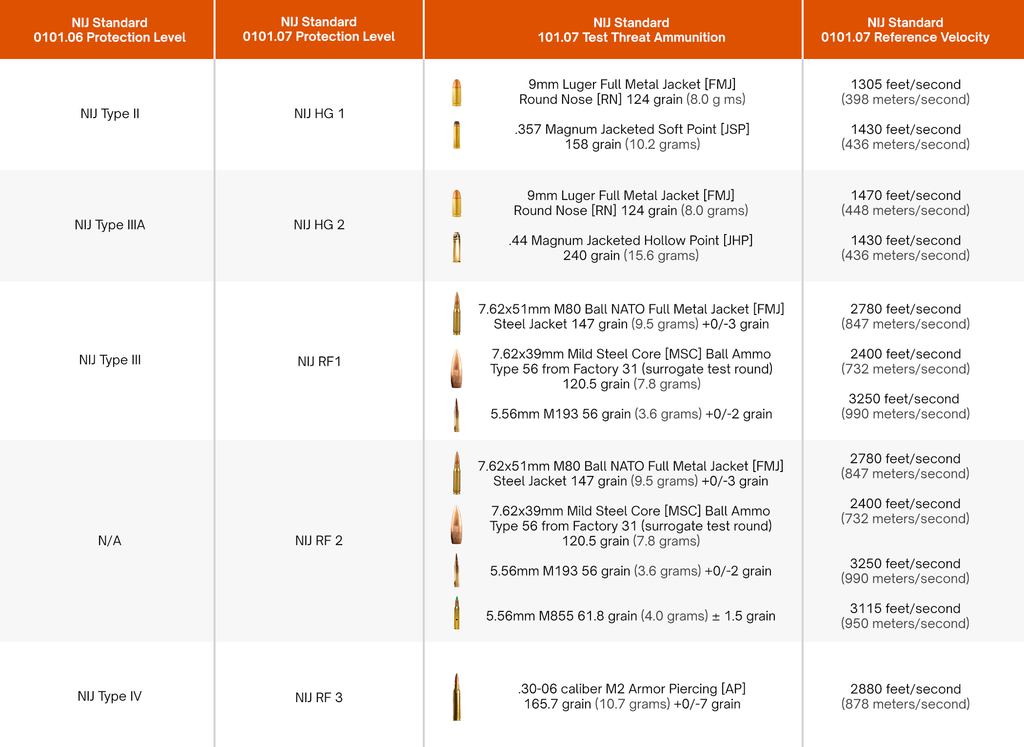
The biggest user-visible change is the new naming. In the past, the threat levels lived inside 0101.06 alongside the test methodology. Now they live in their own document, 0123.00, which means NIJ can update the threat list (when ammunition trends change) without touching the testing standard. The Roman numerals are gone. In their place are two prefixes: HG for handgun, RF for rifle, plus a numeric tier.
Handgun threats: HG1 and HG2
HG1 replaces NIJ Level II. The reference threats are 9mm Luger FMJ RN 124-grain at 1,305 ft/s (398 m/s) and .357 Magnum JSP 158-grain at 1,430 ft/s (436 m/s). HG1 is soft armor sized for the realistic patrol-handgun threat.
HG2 replaces NIJ Level IIIA. The reference threats are 9mm Luger FMJ RN 124-grain at 1,470 ft/s (448 m/s) and .44 Magnum JHP 240-grain at 1,430 ft/s (436 m/s). The .357 SIG round that 0101.06 IIIA tested against has been retired. The faster 9 mm is the higher-energy stand-in.
Level IIA, the lightest 0101.06 tier, has been eliminated entirely. Level I, retired decades ago, does not appear in 0123.00 either.
Rifle threats: RF1, RF2, and RF3
This is where the standard expands rather than just renames.
RF1 replaces Level III. RF1 is now tested against three rifle threats, not the single 7.62 NATO round that 0101.06 used:
- 7.62x51mm M80 Ball NATO FMJ Steel Jacket, 147-grain, at 2,780 ft/s (847 m/s)
- 7.62x39mm Mild Steel Core (MSC) Type 56 from Factory 31, at 2,400 ft/s (732 m/s)
- 5.56mm M193, 56-grain, at 3,250 ft/s (990 m/s)
RF2 is brand new. It covers everything RF1 covers, plus 5.56mm M855 (the steel-tip "green-tip" round) at 61.8-grain, 3,115 ft/s (950 m/s). Before 0101.07, this gap is what manufacturers were trying to fill with the unofficial "Level III+" label. RF2 formalizes the tier.
RF3 replaces Level IV. The reference threat is unchanged: a single .30-06 M2 AP round, 165.7-grain, at 2,880 ft/s (878 m/s). Like Level IV, it is a single-shot rating against an armor-piercing round.
What about the old "+" ratings?
Manufacturer designations like Level IIIA+ and Level III+ never were NIJ ratings. They indicated extended in-house or independent lab testing beyond the official 0101.06 test set. The new RF2 tier replaces most legitimate III+ products with a properly defined and NIJ-tested level. Once an 0101.07 Compliant Products List is published, expect the III+ label to fade. Until then, ask any vendor offering "RF2" or "III+" gear for the lab report and confirm the testing facility is on the NIJ-approved list.
0101.06 to 0101.07 crosswalk table
| Old (0101.06) | New (0123.00) | Reference threats and velocities |
|---|---|---|
| Level I | Eliminated | Retired decades ago |
| Level IIA | Eliminated | Folded into HG1 |
| Level II | HG1 | 9mm 124gr @ 1,305 ft/s; .357 Mag JSP 158gr @ 1,430 ft/s |
| Level IIIA | HG2 | 9mm 124gr @ 1,470 ft/s; .44 Mag JHP 240gr @ 1,430 ft/s |
| Level III | RF1 | 7.62x51 M80 @ 2,780 ft/s; 7.62x39 MSC @ 2,400 ft/s; 5.56 M193 @ 3,250 ft/s |
| (none) | RF2 (new) | All RF1 threats plus 5.56 M855 61.8gr @ 3,115 ft/s |
| Level IV | RF3 | .30-06 M2 AP 165.7gr @ 2,880 ft/s (single shot) |
Velocity values come directly from Tables 1 and 2 of NIJ Standard 0123.00 (NCJ 307347, October 2023). Ammunition identifiers reference the NIJ-maintained webpage at NIJ.ojp.gov/standard-0123-00, which lists the specific commercial part numbers acceptable for each test threat.
What this means for users and the body armor industry
If you wear body armor
Keep wearing it. The rating on a 0101.06 vest still describes what the armor can stop. The vast majority of the more than 400 models on the 0101.06 Compliant Products List remain NIJ Listed and will be maintained on the CPL through end of CY 2027 at the earliest. That gives users and agencies a multi-year window to migrate to 0101.07-tested gear at the natural replacement cycle.
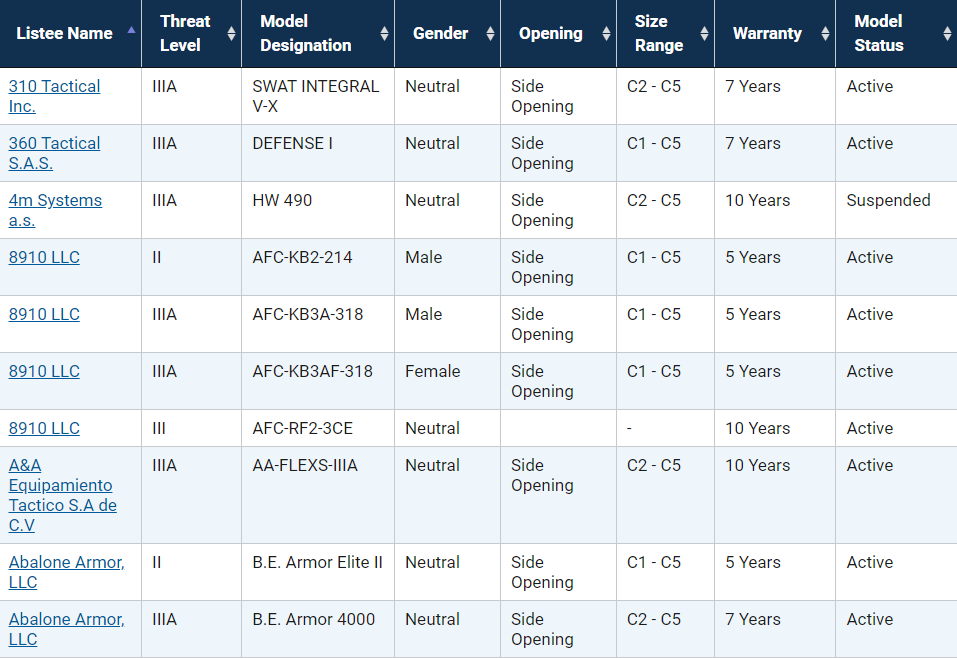
If you are buying right now, an 0101.06 IIIA (HG2-equivalent) soft vest from the CPL is still the cleanest claim available. If you are buying hard plates and the vendor offers an option labeled RF2, ask for the test report and confirm the testing lab.
If you manufacture body armor
The NIJ Compliance Testing Program is the path to listing. Manufacturers register in the Testing Information Management System (TIMS), complete an Applicant Agreement, and submit product through an NIJ-approved lab. As of January 5, 2024, the .06 CPL stopped accepting new applications. Final adjudications on the .06 list are now closed. The active path forward is the 0101.07 program.
If you operate a ballistics testing lab
NIJ-approved labs interested in offering 0101.07 testing should email bactp@nijctp.org. Further details on lab participation in the Compliance Testing Program are available through the Criminal Justice Testing and Evaluation Consortium. Models still active on the .06 CPL undergo Follow-up Inspection Testing (FIT) for as long as the .06 CPL is publicly available.
Frequently asked questions
When was NIJ Standard 0101.07 published?
The NIJ Standard 0101.07 (Ballistic Resistance of Body Armor) was published in late 2023 alongside the companion threat-level specification NIJ Standard 0123.00 (NCJ 307347), which carries an October 2023 cover date. The 0123.00 document has since received two addenda: Addendum 1 on November 13, 2024 and Addendum 2 on July 8, 2025.
What is the difference between RF1 and RF2?
RF1 is tested against three rifle threats: 7.62x51 M80 NATO at 2,780 ft/s, 7.62x39 mild steel core at 2,400 ft/s, and 5.56 M193 at 3,250 ft/s. RF2 covers all three RF1 threats plus 5.56 M855 (the steel-penetrator "green tip") at 3,115 ft/s. RF2 is the new intermediate tier between the old Level III and Level IV, and it is the official replacement for unofficial "Level III+" plates.
Does HG2 stop the same threats as the old IIIA?
The 9mm and .44 Magnum reference rounds carry over. HG2 keeps the IIIA 9mm at 1,470 ft/s and .44 Magnum at 1,430 ft/s. The .357 SIG round that 0101.06 IIIA tested against has been retired in favor of the higher-velocity 9 mm. Practically speaking, an HG2 panel covers the same handgun-class threats a IIIA panel did and is tested with a slightly leaner, current-threat round set.
Are my old Level IIIA or Level IV plates still good?
Yes. The level rating on a 0101.06 vest still describes what the armor stops. NIJ has confirmed the .06 Compliant Products List is maintained through at least end of CY 2027, and existing CPL-listed vests remain NIJ Listed throughout that period. Replace at the natural end of life or when the manufacturer's stated service life expires. Do not throw away functional armor because of the standard change.
What happened to Level IIA and Level I?
Level I was retired decades ago and never appeared in 0101.06's main testing flow. Level IIA, the lowest still-tested .06 tier, has been eliminated under 0101.07. The new HG1 tier absorbs the Level II handgun threat profile. Vendors selling new soft armor will typically offer HG1 (former Level II) and HG2 (former Level IIIA).
Is there a Level V coming?
No. The 0123.00 standard explicitly identifies five protection levels: HG1, HG2, RF1, RF2, RF3. NIJ retains the ability to add tiers later if the prevalent ballistic threats change, but as of the publication of NIJ Standard 0123.00 there is no level above RF3.
What does "NIJ certified" actually mean?
The defensible phrasing is "NIJ Listed on the Compliant Products List" (a model has been tested at an NIJ-approved lab and adjudicated onto the CPL) or "tested to NIJ 0101.06 [or 0101.07] parameters at [named lab]." A vendor saying "NIJ 0101.07 certified" today is making a claim that no manufacturer can yet substantiate, because the 0101.07 CPL itself is still being populated. Anything stronger than "tested to" without a CPL listing risks an FTC issue under 16 CFR Part 255.
Disclaimer: This article describes NIJ Standard 0101.07 and the companion specification 0123.00 as published in late 2023, with the addenda issued through July 8, 2025. Body armor performance depends on fit, panel orientation, panel age, exposure history, and the specific threat encountered. Federal law (18 U.S.C. § 931) restricts possession by anyone convicted of a felony "crime of violence." Verify the legal status of body armor in your state before purchase and follow the care and replacement schedule from the manufacturer.